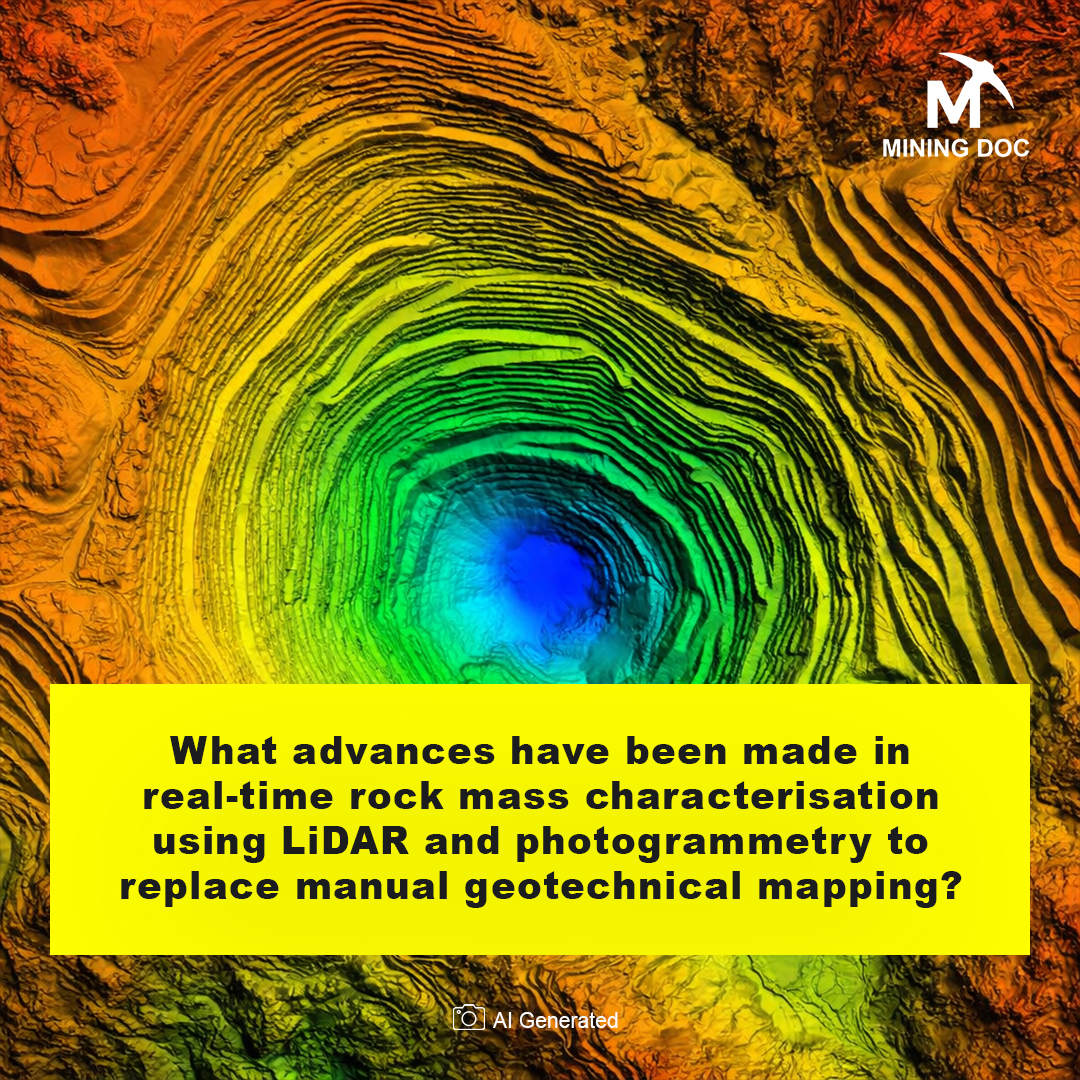
Rock Mass Characterization involves evaluating the engineering properties of rock masses in terms of discontinuities to evaluate structural integrity (Janiszewski et al., 2023). LiDAR employs laser pulses in creating an accurate 3-dimensional point cloud, while photogrammetry refers to a passive technique of acquiring complicated 3D forms from overlapped 2D photos.
In the past, traditional methods of geological mapping used tools such as compasses. Traditional mapping techniques are subjective and dangerous because they expose engineers to risky situations. Consequently, remote sensing techniques have gained importance as essential alternatives for data acquisition (Chen et al., 2025).
Photogrammetric methods have evolved substantially with the use of Unmanned Aerial Vehicles (UAVs). The UAVs fill in any ground level observation gaps and collect all imagery data from appropriate angles on hard-to-reach rock surfaces (Salvini et al., 2016). Modern algorithms convert the image data into a photorealistic 3D model to derive plane orientations digitally.
The LiDAR development consists of compact Terrestrial Laser Scanning (TLS) devices providing extremely high spatial accuracy. This sub-millimeter accuracy is essential for obtaining joint roughness measurements. By creating millions of data points, LiDAR technology eliminates conventional scanlines in favor of accurate discontinuity assessment.
The combination of 3D point clouds with automated methods constitutes a revolutionary advancement in technology. Modern clustering technologies can automatically divide unorganized data into different clusters depending on the orientation planes of structures (Chen et al., 2025). Such an advanced system enables fast identification of geometrical parameters, thereby facilitating the development of accurate Discrete Fracture Networks.
Manual mapping is regarded as one of the greatest shifts in geotechnics since it has been replaced by Lidar and photogrammetry techniques. These advanced approaches not only enable more accurate mapping but also ensure greater safety for the workers due to remote analysis of the structures. Automation in slope stability analysis will enhance its perfection in the future (Gou et al., 2024).
The shift from the old-school manual mapping to the use of sophisticated remote sensing methods such as LiDAR and photogrammetry signifies an important breakthrough in the process of rock mass characterization. The new methods not only rule out the potential inaccuracies and inherent dangers involved in the traditional compass method of assessing rock formations but also offer increased spatial accuracy and resolution. Thanks to their capability to facilitate automatic discontinuity detection, efficient geometrical parameter determination, and creation of highly detailed 3D models, the adoption of LiDAR and UAV-supported photogrammetry has improved the reliability and safety of rock assessment processes considerably. The rise of automation in this sphere, especially slope stability analysis, ensures a bright future ahead.
References
Chen, J., Li, H., Jiang, N., et al. (2025). Stability evaluation of shallow blocks in high and steep slope combining TLS and UAV photogrammetry. Geomatics, Natural Hazards and Risk, 16. https://doi.org/10.1080/19475705.2025.2464052
Gou, Q., Wang, P., Jing, G., & Cai, M. (2024). Influence of 3D joint roughness on fracture behaviours of rock mass subjected to compression. Geomatics, Natural Hazards and Risk, 15. https://doi.org/10.1080/19475705.2024.2385626
Janiszewski, M., Prittinen, M., Uotinen, L., Torkan, M., & Rinne, M. (2023). Rapid photogrammetric method for rock mass characterization in underground excavations. The IV Nordic Symposium on Rock Mechanics and Rock Engineering – Proceedings. https://doi.org/10.33112/nrock2023.20
Salvini, R., Mastrorocco, G., Seddaiu, M., Rossi, D., & Vanneschi, C. (2016). The use of an unmanned aerial vehicle for fracture mapping within a marble quarry (Carrara, Italy): photogrammetry and discrete fracture network modelling. Geomatics, Natural Hazards and Risk, 8, 34–52. https://doi.org/10.1080/19475705.2016.1199053