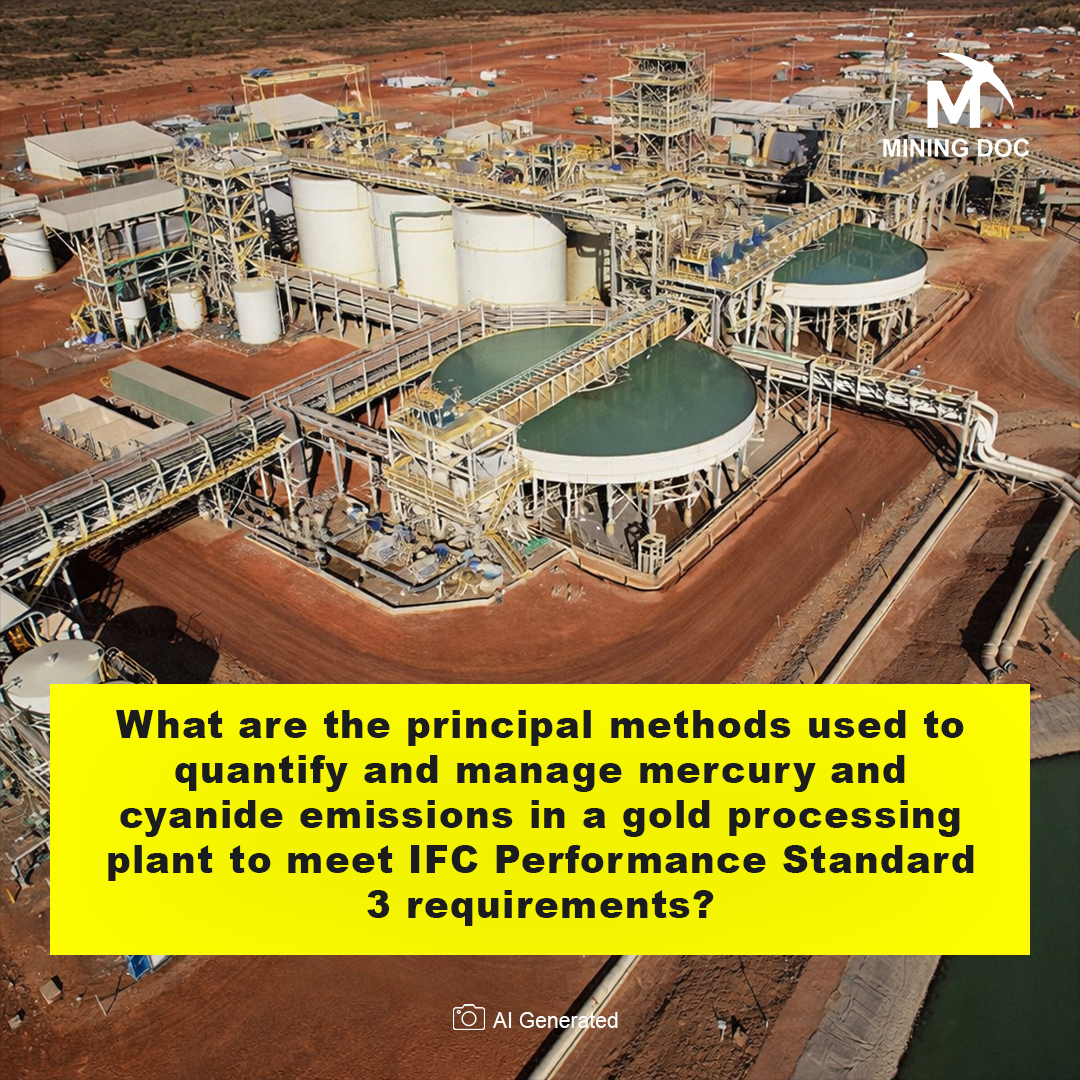
IFC Performance Standard 3 (PS3) emphasizes resource efficiency and strict pollution prevention measures for industrial activities. In gold mining, meeting the PS3 standard necessitates strict control measures for two of the main dangerous substances involved in the process, which include mercury (Hg) and cyanide (CN). Gold extraction using mercury entails amalgamation with Hg, while the process involving CN uses the formation of stable compounds in an alkaline solution (Surimbayev et al., 2025). Familiarity with these processes and their potential effects is essential when addressing adverse effects to the environment and communities.
Mercury quantification in gold processing is challenging due to several factors. For many operations, especially small-scale operations that are adopting these practices, the quantification process depends on mass balancing. In this technique, the total annual volume of Hg used in the gold ore is estimated and compared to the total amount recycled or recovered (Keane et al., 2023). However, advanced processes such as amalgamation can use Continuous Emissions Monitoring Systems (CEMS) to quantify Hg vaporized through heating processes.
However, when dealing with mercury management as part of IFC PS3 criteria, the mining processing plant should establish pollution prevention plans. One of the key aspects of managing mercury is the reduction of this substance with time because of environmental and socio-economic reasons (Malone et al., 2023). If the substance is employed for a temporary period, then the operations can manage the emissions by establishing retorts or other devices to capture the vaporized mercury before releasing it into the air.
The quantification of cyanide needs to be done using an entirely different procedure because of the nature of cyanide and how it operates in the environment. This chemical is very reactive with other trace metals. Therefore, environmental measurements have to distinguish between free cyanide, Weak Acid Dissociable (WAD) cyanide, and cyanide in complexes within tailings and water reservoirs (Hidayati et al., 2009). Mining processing plants use spectroscopic and titrimetric techniques to regularly monitor the concentration of WAD cyanide.
Cyanide management according to IFC PS3 is greatly concerned with detoxification prior to any disposal into the environment. For instance, the use of chemical destruction techniques by plants includes the use of the INCO sulfur dioxide/air process in breaking down the cyanide to cyanates. Also, it is essential for plant operators to manage the transition between amalgamation and cyanidation to avoid creating highly toxic and mobile mercury-cyanide complexes (Malone et al., 2023).
To conclude, ensuring compliance with IFC PS3 in gold processing requires a constant effort at technological advancement when it comes to assessing and neutralizing emissions. With mass balance tracking, chemical detoxification, and transition from amalgamation, processing plants can significantly reduce their environmental impact.
References
Hidayati, N., Juhaeti, T., & Syarif, F. (2009). Mercury and cyanide contaminations in gold mine environment and possible solution of cleaning up by using phytoextraction. HAYATI Journal of Biosciences, 16(3), 88–94. https://doi.org/10.4308/hjb.16.3.88
Keane, S., Bernaudat, L., Davis, K. J., et al. (2023). Mercury and artisanal and small-scale gold mining: Review of global use estimates and considerations for promoting mercury-free alternatives. Ambio, 52, 833–852. https://doi.org/10.1007/s13280-023-01843-2
Malone, A., Figueroa, L., Wang, W., et al. (2023). Transitional dynamics from mercury to cyanide-based processing in artisanal and small-scale gold mining: Social, economic, geochemical, and environmental considerations. Science of The Total Environment, 898, 165492. https://doi.org/10.1016/j.scitotenv.2023.165492
Surimbayev, B., Bolotova, L., Akcil, A., et al. (2025). Technology development of gold heap leaching in Kazakhstan: An overview. Mineral Processing and Extractive Metallurgy Review. https://doi.org/10.1080/08827508.2024.2448786