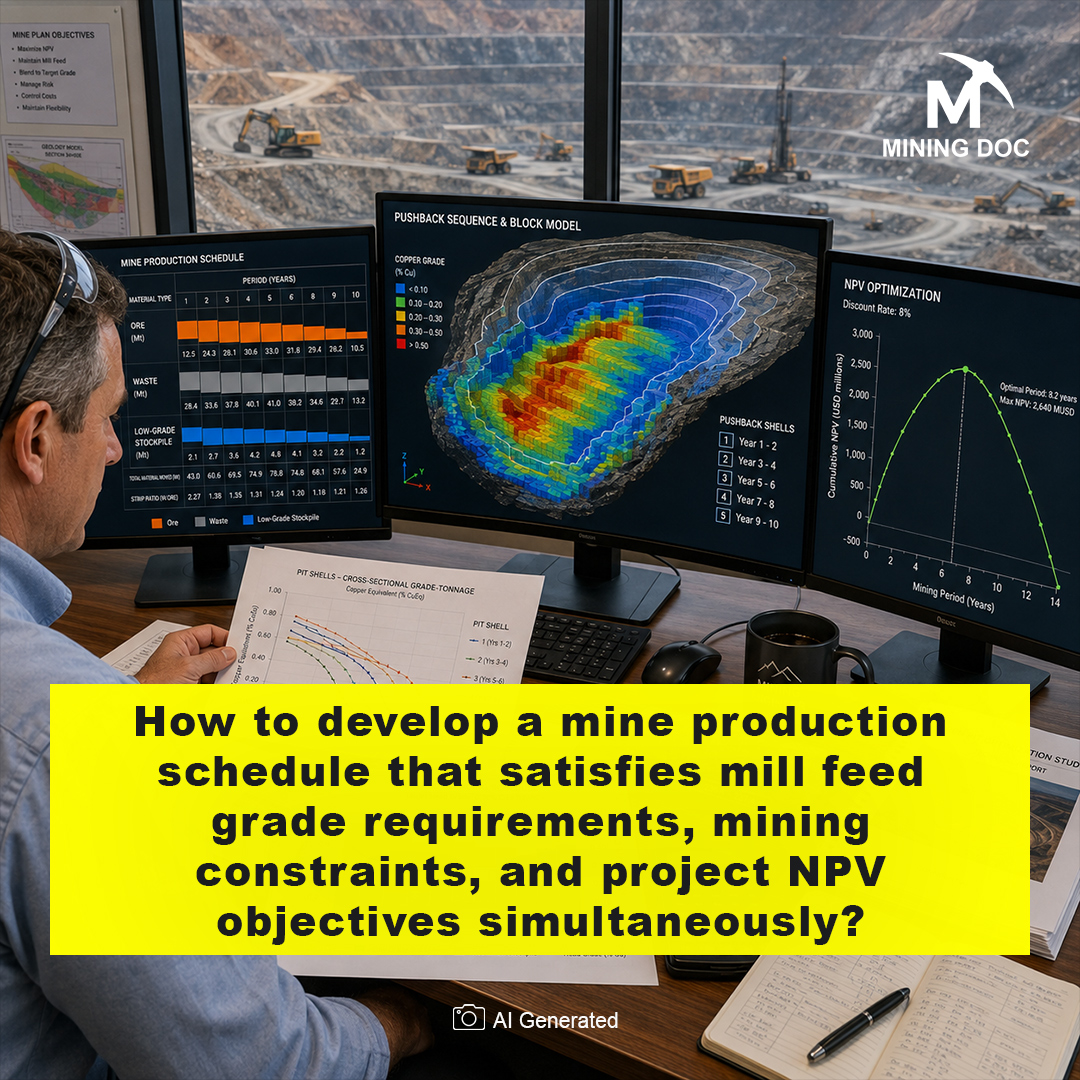
The creation of a mine production schedule calls for putting together a complicated puzzle where reality blends with financial aspirations. A mine production schedule refers to the timetable that defines how certain earth blocks will be extracted, the time when this extraction will take place, and their destination point (Astudillo & Rancel, 2023). The term “mill feed grade” or “head grade” refers to the real mineral content that gets into the mill for processing. These extraction processes are regulated according to certain mining constraints, including physical constraints on extraction rates and sequencing (Burt, Caccetta, Fouché, & Welgama, 2016). This overall objective function is represented by the net present value (NPV).
The adherence to mill feed grade specifications requires careful blend planning to achieve very consistent results. Inevitable grade variations within the orebody are common, as well as the fact that metal recoveries depend greatly on changes in head grade. When the grade of delivered ore is below the specification, operations become less efficient; if the grade is too high, there is a risk of capacity limitations or lack of reagents. In terms of planning, temporary stockpiles serve as a buffer for lower-grade material that is accumulated during periods of high grade and blended back into the feed later (Albor Consuegra & Dimitrakopoulos, 2024).
The process of implementing the schedule is inherently constrained due to the strict requirements for mining operations concerning the geometry and rate of excavation. There is a necessity for geotechnical stability to ensure certain slope angles of the mine, implying that the sequence of operation must involve stripping of the overburden layers first before mining of the ore below (Moreno, Espinoza, & Goycoolea, 2020). At the same time, the capacity of equipment, including the fleet of drills, excavators, and haul trucks, sets an absolute limit on the amount of material that can be processed within the period of time. The physical space available on the bench limits the number of machines which can work at a particular face at once.
The financial core of scheduling lies in the aim of maximizing project NPV. Being motivated by the discount rate, which considers time value of money and operation risk, cash flow that occurs earlier in the lifetime of the mine has much greater value than that occurring several decades later. As such, from the economic point of view, there is an imperative to concentrate on extraction of high-grade and close to surface ore in the first stages of the sequence (Dimitrakopoulos, Farrelly, & Godoy, 2002). The policy of cut-off grade is tightly connected with this idea, and instead of being fixed at the level of breakeven point, it often grows dynamically in the first years.
It is essential to have advanced math techniques to reconcile the significant contradiction between ensuring constant supply of mill, considering physical limitations, and striving for fast NPV. The current strategy of mining operation involves the utilization of MIP (Mixed-Integer Programming), which is a tool able to test millions of block sequencing to generate paths maximizing profit under the condition of strict fulfillment of linear constraints (Burt et al., 2016). Due to the complexity of both open-pit and underground scheduling tasks, it is common practice to use OR heuristics and metaheuristics such as simulated annealing and dedicated software to find near-optimal solutions (Moreno et al., 2020).
The fusion of feed grade, scheduling restrictions, and NPV is achieved through a decision-making approach that recognizes mine planning as a dynamic risk management process. Compromises are inevitable since aiming for the maximum possible NPV through intense high grading of the deposit can lead to a disruption of the long-term spatial sequence or create low-grade piles that will never be used. In addition, any form of a deterministic schedule is susceptible to uncertainties in terms of grade and market prices and hence the growing preference for stochastic optimization processes which produce robust sequences under various geological realities (Astudillo & Rancel, 2023).
References
Albor Consuegra, L. C., & Dimitrakopoulos, R. (2024). Integrated stochastic underground mine planning with long-term stockpiling: Method and impacts of using high-order sequential simulations. Minerals, 14(2), 123. https://doi.org/10.3390/min14020123
Astudillo, C., & Rancel, N. (2023). A multi-stage methodology for long-term open-pit mine production planning under ore grade uncertainty. Mathematics, 11(18), 3907. https://doi.org/10.3390/math11183907
Burt, C., Caccetta, L., Fouché, L., & Welgama, P. (2016). An MILP approach to multi-location, multi-period equipment selection for surface mining with case studies. Journal of Industrial and Management Optimization, 12(2), 403–430. https://doi.org/10.3934/jimo.2016.12.403
Dimitrakopoulos, R., Farrelly, C. T., & Godoy, M. (2002). Moving forward from traditional optimization: Grade uncertainty and risk effects in open-pit design. Transactions of the Institutions of Mining and Metallurgy, Section A: Mining Technology, 111(1), A82–A88.
Moreno, E., Espinoza, D., & Goycoolea, M. (2020). Production scheduling for strategic open pit mine planning: A mixed-integer programming approach. Operations Research, 68(5), 1425–1444.