While reading guidance on long-term mine closure planning, I came across a statement that immediately caught my attention:
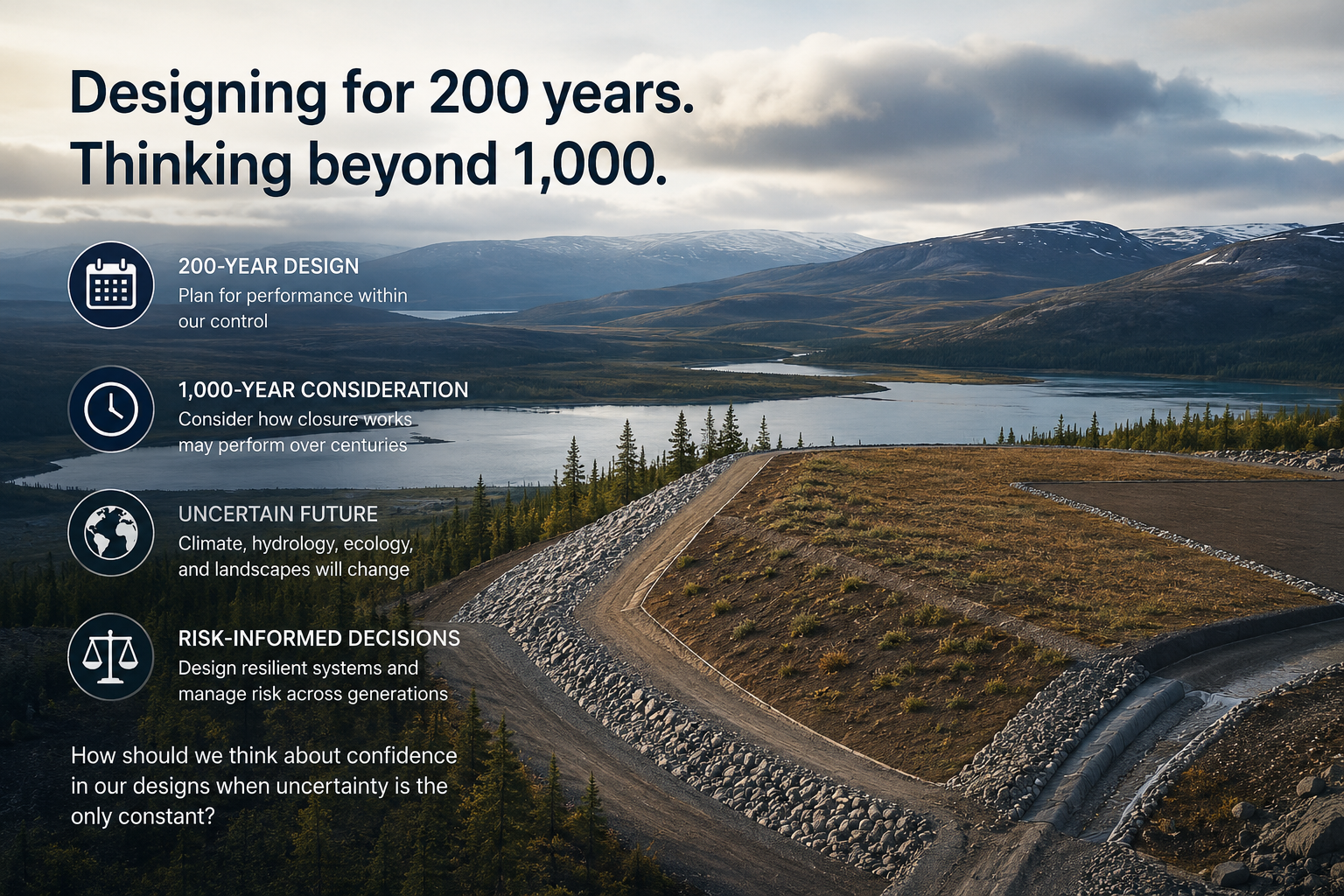
The federal agency responsible for mine closure in Northern Canada is calling for a 200-year closure design period, while also evaluating how closure works may perform over 1,000 years.
At first glance, the distinction seems subtle. The more I thought about it, however, the more significant it became.
A 200-year design period is already well beyond the lifespan of most engineered infrastructure. Extending our thinking to 1,000 years changes the conversation entirely. It asks us to move beyond designing individual components and toward resilient systems capable of accommodating change over timescales that no engineer, company, or institution will directly witness.
That raises an interesting question:
If closure designs must perform for 200 years and remain credible over 1,000, what are we designing for: today’s conditions, or uncertainties we cannot yet define?
From Components to Systems
Engineering often focuses on designing individual components to satisfy specific performance criteria. In mine closure, however, long-term performance depends on how multiple systems interact over time.
Consider a tailings cover. Its long-term performance is not governed solely by the durability of the cover material. Instead, it depends on the interaction of numerous processes that evolve over decades and centuries, including:
- changing climate conditions;
- groundwater flow and hydrogeology;
- vegetation succession;
- erosion and landform evolution;
- freeze-thaw cycles and permafrost dynamics in northern environments;
- geochemical processes occurring within the underlying waste materials.
Each of these factors changes over time, and many interact in ways that cannot be predicted with complete confidence.
This highlights an important reality: closure systems are dynamic rather than static. Their long-term success depends not only on how they are built, but also on how they respond to changing environmental conditions throughout their service life.
Engineering Under Deep Uncertainty
Traditional engineering often relies on defining loads, establishing safety factors, and designing against reasonably foreseeable conditions.
Mine closure introduces a different challenge.
When the performance horizon extends across centuries, uncertainty itself becomes one of the principal design constraints.
Future climate conditions may differ substantially from those observed today. Hydrological regimes may shift. Vegetation communities may evolve. Regulatory expectations and societal values may also change over time.
None of these changes are entirely predictable.
As a result, designing for mine closure becomes less about predicting the future with certainty and more about making robust, risk-informed decisions under deep uncertainty.
That shift has important implications for how we think about design.
Rather than asking whether a closure system will perform exactly as intended for 1,000 years, perhaps a better question is whether it possesses sufficient resilience to continue performing acceptably as conditions inevitably evolve.
Confidence Versus Certainty
One aspect of the statement that particularly resonated with me is the distinction between a design period and a performance evaluation period.
The difference suggests that long-term closure may not be about guaranteeing performance over a millennium. Instead, it may be about demonstrating that the design remains technically defensible when viewed against a much longer horizon of uncertainty.
That changes how we think about engineering confidence.
Confidence may not come solely from stronger materials or larger factors of safety. It may increasingly depend on:
- understanding system interactions;
- identifying key uncertainties;
- incorporating adaptive management where appropriate;
- monitoring performance over time; and
- making transparent, risk-informed decisions throughout the design process.
In other words, resilience may become as important as prediction.
A Question Worth Discussing
Mine closure is often described as one of the most complex engineering challenges because it requires us to design systems that must continue to function long after the mine has closed, the operating company has changed, and the engineers who developed the design are no longer around.
That reality makes me wonder:
How should we think about confidence in our designs when the performance horizon extends far beyond the life of the mine, the company, or even the engineer?
And equally important:
What role should risk-informed design, adaptive management, and systems thinking play when uncertainty itself becomes a primary design constraint?
I’d be interested to hear perspectives from mine planners, geotechnical engineers, hydrogeologists, environmental scientists, closure specialists, and regulators.
Long-term mine closure sits at the intersection of all these disciplines, and these conversations will help our understanding of resilient closure systems continue to evolve.