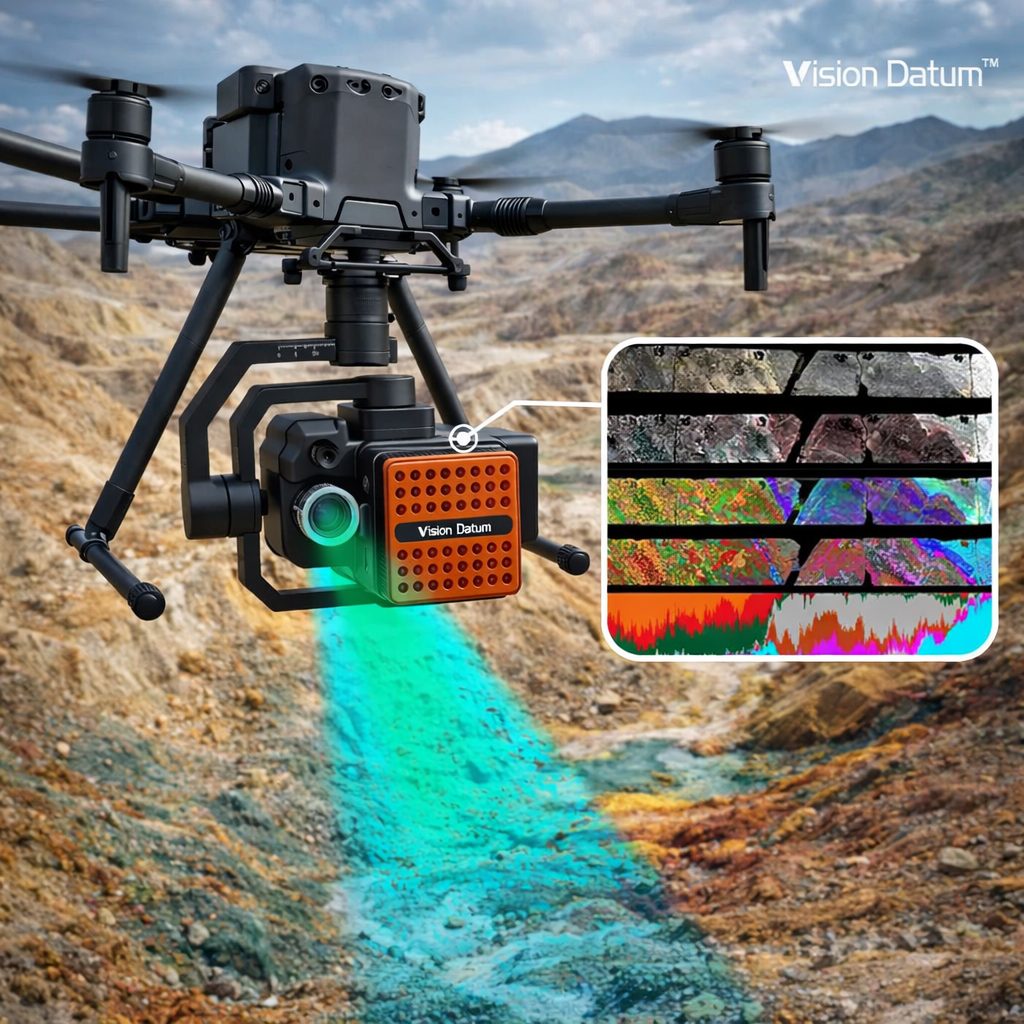
Remote sensing techniques have revolutionized the way mining companies undertake early-stage mineral exploration. Remote sensing refers to the acquisition of information regarding the Earth’s surface through indirect contactless means. The two innovative remote sensing technologies that make a difference are Hyperspectral Imaging (HSI) and drones with geophysics technology.
HSI uses electromagnetic radiations captured from hundreds of very narrow wavelengths per pixel to precisely detect material by making use of their spectral signature (Koerting et al., 2024). Drone geophysics entails installation of geophysical sensors on Uncrewed Aerial Systems (UASs) to detect geological formations underground (Heincke et al., 2019).
Traditionally, ground surveys were conducted using expensive and labor-intensive ground surveys or poor resolution satellite images. Early stage mineral exploration faced challenges in terms of inaccessibility. Fortunately, the development of high-resolution remote sensing has solved these issues. Modern-day drones allow flights of a low altitude which is a compromise between satellite coverage and ground sampling.
HSI technology has turned out to be extremely useful in discerning complicated mineral compositions. As geological formations have particular absorption characteristics in the visible to shortwave infrared range, HSI can quickly map differences in composition among exposed rocks (Kirsch et al., 2018). This way, geologists can locate mineralization zones without digging into the ground, thus speeding up the process of the discovery stage.
Simultaneously, geophysics from the drones becomes an essential source of underground data. Although HSI helps to identify chemical composition of rocks on the surface, drone-mounted magnetometers can find magnetic anomalies and geological formations (Heincke et al., 2019). The combination of magnetic and hyperspectral data collection from drone teams gives a multidimensional picture of the object of exploration.
The incorporation of these technologies makes it possible to increase efficiency, improve safety, and develop optimal sampling approaches. By creating geometrically correct digital representations of outcrops, it becomes possible for explorers to perform the analysis of lithologies without the need to visit the field (Kirsch et al., 2018).
To conclude, the combination of hyperspectral imaging and geophysical methods implemented via drones has revolutionized the process of mineral exploration. The technologies provide high-resolution geological information that directly decreases exploration risks.
References
Heincke, B., Jackisch, R., Saartenoja, A., Salmirinne, H., Rapp, S., Zimmermann, R., … & Middleton, M. (2019). Developing multi-sensor drones for geological mapping and mineral exploration: setup and first results from the MULSEDRO project. Geological Survey of Denmark and Greenland Bulletin, 43. https://doi.org/10.34194/geusb-201943-03-02
Kirsch, M., Lorenz, S., Zimmermann, R., Tusa, L., Möckel, R., Hödl, P., … & Gloaguen, R. (2018). Integration of Terrestrial and Drone-Borne Hyperspectral and Photogrammetric Sensing Methods for Exploration Mapping and Mining Monitoring. Remote Sensing, 10(9), 1366. https://doi.org/10.3390/rs10091366
Koerting, F., Asadzadeh, S., Hildebrand, J. C., Savinova, E., Kouzeli, E., Nikolakopoulos, K., … & Micklethwaite, S. (2024). VNIR-SWIR Imaging Spectroscopy for Mining: Insights for Hyperspectral Drone Applications. Mining, 4(4), 1013-1057. https://doi.org/10.3390/mining4040057
Image rights: Vision Datum (https://shop.visiondatum.com/blogs/blog/how-drone-based-hyperspectral-cameras-are-transforming-geological-mineral-exploration?srsltid=AfmBOorerS1TCct6bMRGp4snuYlJrTRTehwmbmjjVVH5oQZYUubOfHl1)