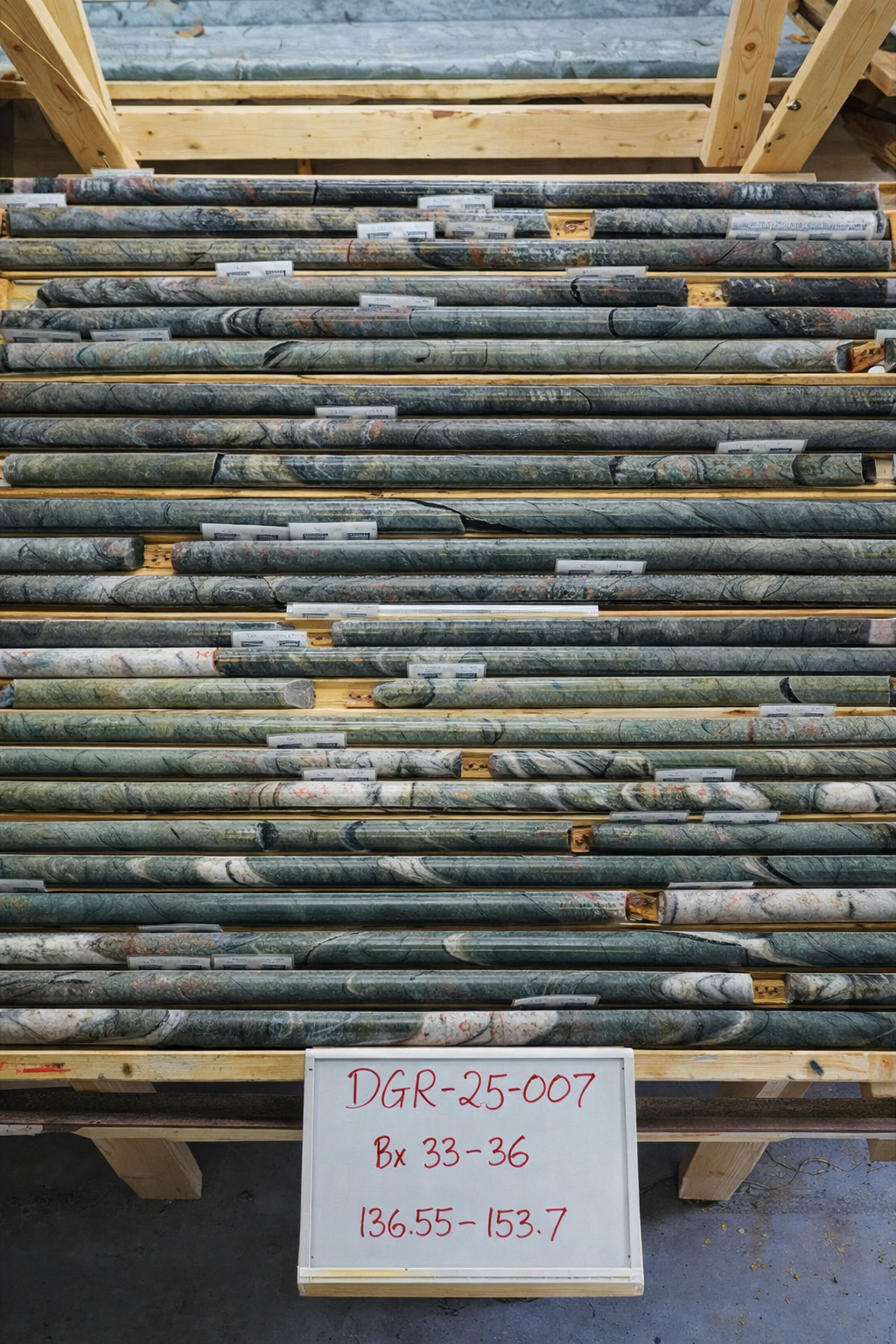
Core logging is the act of measuring the characteristics of drill cores to determine the geological nature of subsurface rocks. In this process, geotechnical discontinuities, which are natural defects within rocks, are logged by engineers. These mainly comprise joints, which have fractures but no shear displacement; faults, which also have fractures but with displacement; and shear zones, which consist of bands of rock that have been deformed (Azad et al., 2024).
The logging of these discontinuities is critical because these defects determine the behavior of rock masses. The traditional method of core logging may sometimes be accompanied by televiewer scanning, providing comprehensive information regarding open discontinuities and the orientation of structures within rocks (Gwynn et al., 2013).
The process of logging joint sets involves a thorough investigation of a number of characteristics on the drill core. The geologist logs the spacing between the joints, surface roughness, weathering degree, and presence of infillings. This information is crucial since it determines the friction value and block size that affect the condition of the joint set according to the classification systems used.
On the contrary, the logging of faults and shear zones is concerned with large-scale deformation mechanisms. In most cases, such structural features have a very weak material filling, such as clay gouge or breccia. Here, the geologist should determine the correct thickness of the zone, shear plane orientation, and strength of the fillings. This step is important since the fault is an important zone of weakness.
The calculation of RQD allows for the conversion of these defects into classification categories. RQD refers to the percentage of intact core samples that are greater than 10 cm in length, offering a quantified description of fracture density (Somodi & Vásárhelyi, 2023). The value obtained during the calculation acts as an important input into rating systems such as RMR and Q-systems (Narimani et al., 2025).
In conclusion, the classification of geotechnical defects along with their logging enables the translation of geological parameters into engineering calculations. Through systematic assessment of the fractures, faults, and shear zones, indices like RQD may be calculated and inputted to modern classification models. This approach will allow for reliable estimates to be made concerning rock mass properties and safe tunnel support designs.
References
Azad, M. A., Najeh, T., Raina, A. K., Singh, N., Ansari, A., Ali, M., Fissha, Y., Gamil, Y., & Singh, S. K. (2024). Development of correlations between various engineering rockmass classification systems using railway tunnel data in Garhwal Himalaya, India. Scientific Reports, 14. https://doi.org/10.1038/s41598-024-60289-y
Gwynn, X., Brown, M., & Mohr, P. (2013). Combined use of traditional core logging and televiewer imaging for practical geotechnical data collection. Proceedings of the 2013 International Symposium on Slope Stability in Open Pit Mining and Civil Engineering. https://doi.org/10.36487/acg_rep/1308_13_mohr
Narimani, S., Davarpanah, S. M., Bar, N., & Vásárhelyi, B. (2025). Analyzing Drill Core Logging Using Rock Quality Designation–60 Years’ Experience from Modifications to Applications. Applied Sciences, 15(3), 1309. https://doi.org/10.3390/app15031309
Somodi, G., & Vásárhelyi, B. (2023). Borehole Analysis with the Modification of RQD Value. Geotechnics, 3(4), 1017–1032. https://doi.org/10.3390/geotechnics3040055
Image rights: Nikolay Rusanov (Instagram)