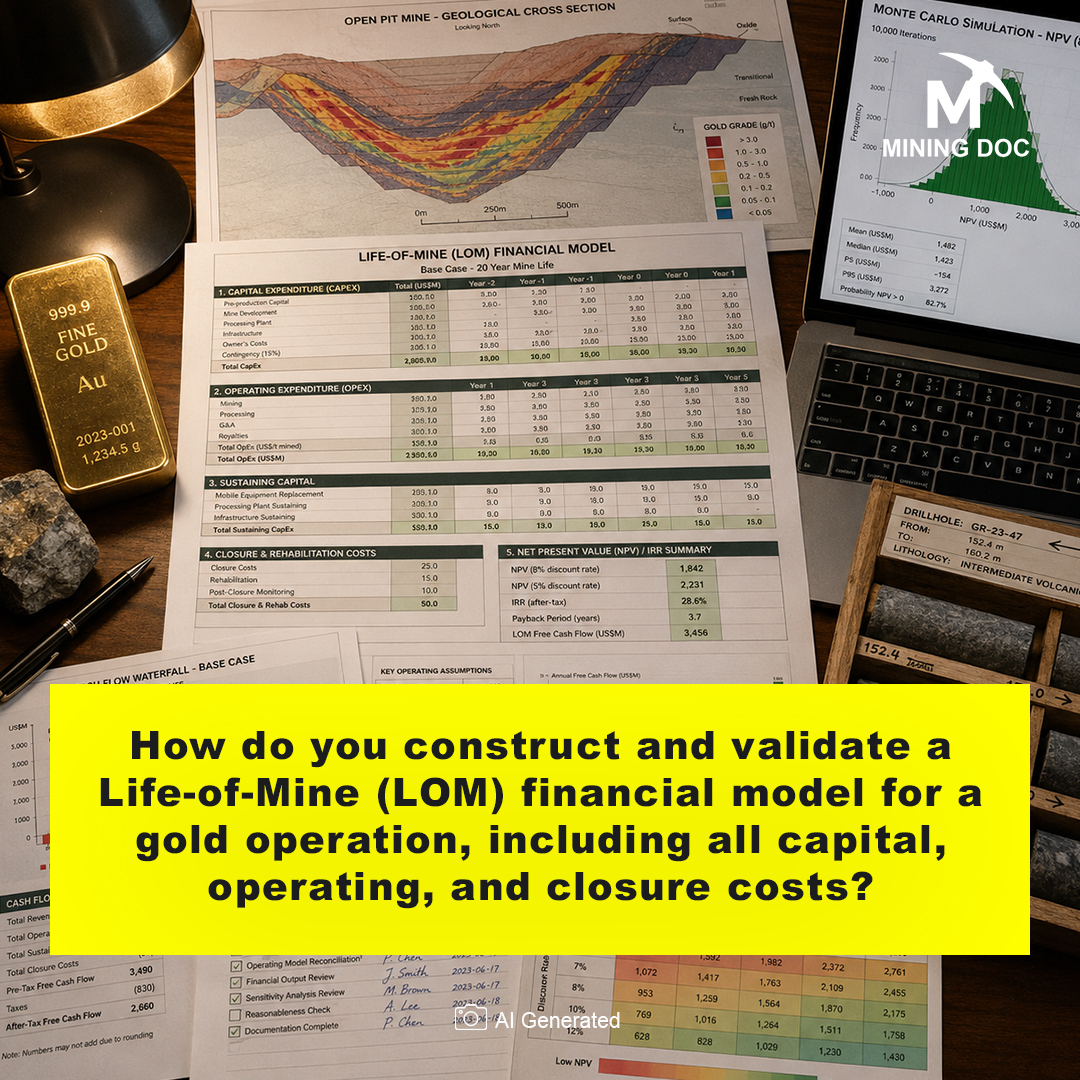
The construction a Life-of-Mine financial model for a gold project helps figure out if it’s economically viable in the long run. This model forecasts revenues and expenses using a discounted cash flow method. It covers big initial infrastructure costs – that’s CAPEX – along with daily operational costs, including workforce wages and processing fees – that’s OPEX. Plus, there are the funds set aside for the mine’s eventual decommissioning and environmental cleanup.
The cornerstone of an LOM model lies in precise geological data. Using estimated resources and block models, planners design how and when the gold will be extracted. The decision on the cut-off grade, which is basically the least amount of gold you need to make the venture worthwhile, is crucial (Birch, 2017). By charting out this plan, engineers predict the volume and quality of ore that’ll be processed, thus setting the tone for how long the operation will run.
Cost estimation for a project involves accurate modeling of CAPEX and OPEX. Initial CAPEX includes big investments in things like shaft sinking, building processing plants, and setting up tailings facilities. Then there’s sustaining CAPEX which covers the ongoing need to replace equipment. OPEX is super sensitive to decisions about mining rates, processing capacities, and overhead costs (Toro Morales et al., 2024). Getting these cost projections right means the model actually shows how much it will truly cost to get the gold out and refine it.
Economic factors guide the cash that comes in. Experts predict revenue by using forecasted gold prices along with expected recovery rates for the mined ore. They account for profitability by folding in royalty payments, corporate taxes, and refining costs. In the end, the net cash flows are discounted to find their present value. The goal here is to maximize the Net Present Value (NPV) through good long-term planning (Dimitrakopoulos & Jewbali, 2013).
The creation of a strong LOM model requires considering mine closure and putting it through tough math checks. Adding the costs for shutting down and cleaning up the site from the start helps avoid big money surprises later on (Sanders & Fitzpatrick, 2022). Validators run sensitivity analyses and Monte Carlo simulations to stress-test the NPV. They look at how swings in gold prices and input costs could hit the finances.
At its core, building and checking this model needs teamwork and lots of tweaking. When mining firms include accurate geology info, CAPEX and OPEX guesses, decent revenue forecasts, and complete shutdown costs, they can weather economic storms better. All of this gives them control over ops, boosts the asset’s worth, and keeps the environment safe in the long run.
References
Birch, C. (2017). Optimization of cut-off grades considering grade uncertainty in narrow, tabular gold deposits. Journal of the Southern African Institute of Mining and Metallurgy, 117, 149–156. https://doi.org/10.17159/2411-9717/2017/v117n2a6
Dimitrakopoulos, R., & Jewbali, A. (2013). Joint stochastic optimisation of short and long term mine production planning: method and application in a large operating gold mine. Mining Technology, 122, 110–123. https://doi.org/10.1179/1743286313y.0000000040
Sanders, J., & Fitzpatrick, A. (2022). A Peruvian case study: optimising mine planning through mine closure decision assessment. Proceedings of the International Conference on Mine Closure, 713–724. https://doi.org/10.36487/acg_repo/2215_5
Toro Morales, D. A., Franco Sepúlveda, G., de la Barra, E., & Del Río Cuervo, J. C. (2024). Cutoff Grade Optimization on Operative Decision Variables with Geological Uncertainty in an Underground Gold Mine: A Real Case Study. Mathematics, 12, 3450. https://doi.org/10.3390/math12223450