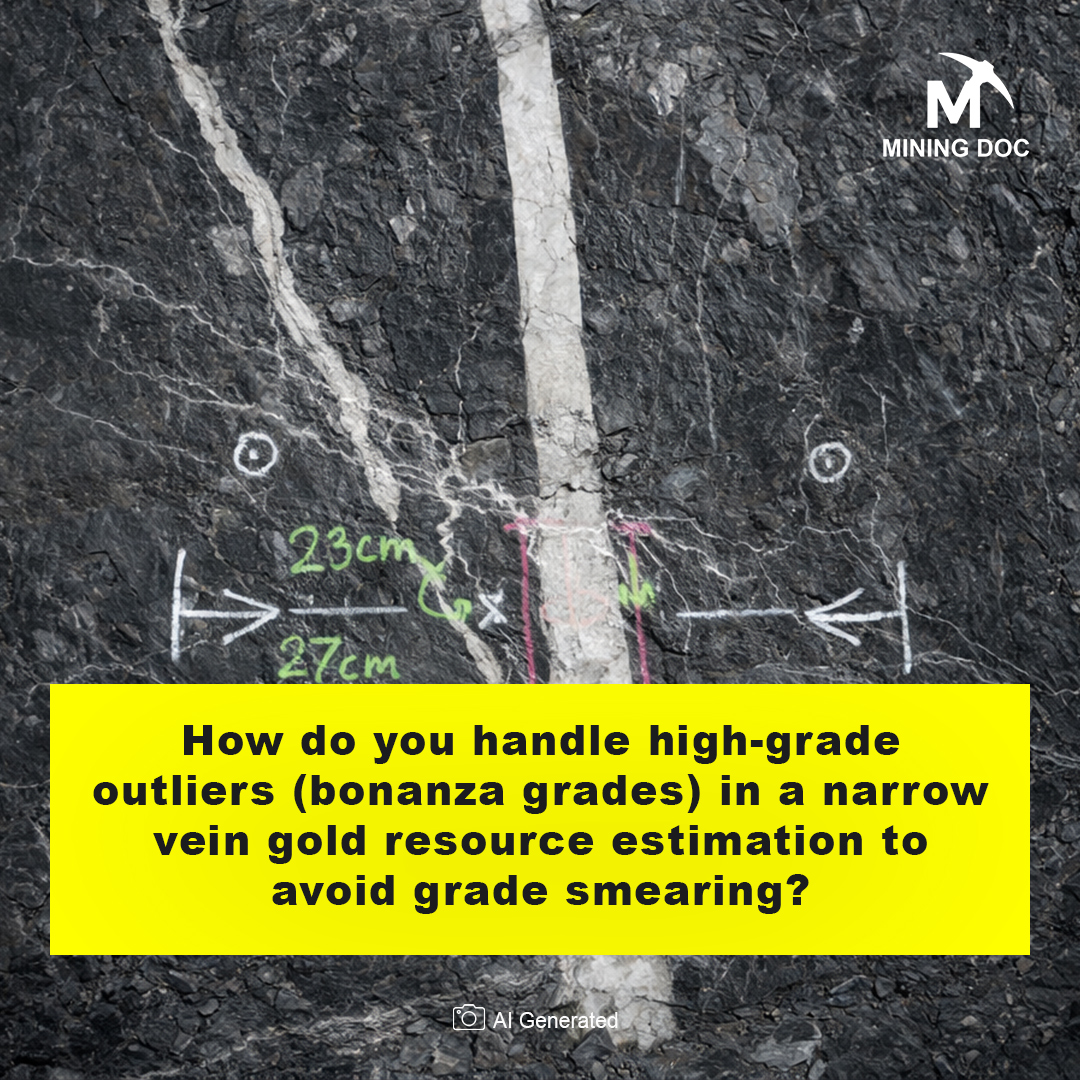
In mineral resource estimation, precise metal estimation of narrow vein deposits necessitates careful consideration of extremes in the data. In narrow vein deposits, there exists a high-grade mineralization that is concentrated in structurally controlled conduits, such as shears quartz vein deposits.
In the system, exploratory drill holes frequently encounter “bonanza” grades, which are exceptionally high gold grades that do not belong to the rest of the data distribution. Failure to control for this anomaly when interpolating results in grade smearing. Grade smearing entails the artificial extension of high-grade data in the areas of low-grade or barren rocks, causing an extreme overestimation of the grade and metal of the local block (Leuangthong & Nowak, 2015).
The narrow vein gold deposits stand out as highly vulnerable to grade smearing based on a number of geological attributes and sampling issues, all of which are reflected by a high “nugget effect” of gold deposits (Dominy et al., 2021). Gold tends to form coarse grains and clusters instead of being evenly distributed (Dominy et al., 2021).
The formation of such clusters leads to very high variability in short distances because two holes drilled only one meter apart can provide significantly different assays (Dominy et al., 2018). There is also an issue of disparity between samples as the size variance between a slim drill core sample and a large SMU block. If a core hits a cluster of coarse gold, then the bonanza grade is very small physically speaking. Using this high grade in the whole mining block without any correction does not match the vein geometry at all.
However, before spatial interpolation occurs, resource geologists make use of statistical analyses to address these outliers. The most common method used is that of grade capping, or “top cutting,” whereby the highest grade that can be contributed by an assay to the estimation process is capped at a particular level (Fourie et al., 2019).
This cap is established through probability plots, histograms, and decile or cumulative frequency analyses carried out by geostatisticians to establish exactly the value point after which the high-grade tail becomes spatially discontinuous. Although this process has been effective in preventing extreme values from influencing the variogram and interpolator, the capping process should be exercised with caution as excessive capping results in the loss of valuable metallic content, thus economic underestimation, whereas inadequate capping causes grade smearing (Dutaut & Marcotte, 2021).
In addition to statistical top-cuts, spatial restrictions are employed through OK search parameter configurations as a way to control high-grade influence. Rather than using statistical top-cuts only, spatial restrictions are put in place through OK search parameters including the restriction of the search radii of high-grade samples (Leuangthong & Nowak, 2015).
Here, an un-capped bonanza grade will affect blocks within a short radius (for instance 5 to 10 meters) but at radii longer than that one, a capped value is used. More sophisticated methods like Indicator Kriging (IK) and Multiple Indicator Kriging (MIK) do not need any capping since they use the probability of exceeding the different cut-off grades which helps in naturally controlling extreme values (Rossi & Deutsch, 2014). Furthermore, setting up kriging plans using octant search restrictions and maximum samples limits avoid biasing the block estimate due to high-grade interceptions.
Aside from algorithmic fixes, the best way to prevent smearing is rigorous domaining and validation in geology. The creation of hard-boundary 3D wireframes that literally separate high-grade shoots from low-grade areas prevents the interpolation of bonanza grades through geological boundaries (Leuangthong & Nowak, 2015).
In addition to domaining, prior to estimation, the assay values have to be composited in order to create a uniform interval length, resulting in a natural dilution of the narrow, high-grade intervals in sample support (Fourie et al., 2019).
After the block model has been filled with data, it passes the validation process. Geological experts use various tools including declustering, cross-section checking, and swath plotting to make sure that the block grades respect the data both locally and globally. The final test of validity of the model is the reconciliation with mill production data from history.
All in all, dealing with high-grade outliers at narrow-vein gold deposits involves a careful balance between geological truth and math. One should abandon an idea of using global grade capping and switch to a more efficient combination of hard-boundary domaining, local top-cutting and limited ellipsoidal search areas. Setting up a solid and audit-proof approach to working with data is an obligatory step for any company aiming to conform to international requirements set by the CIM guidelines (NI 43-101), JORC, or SAMREC. This will allow resource geologists to create reliable block models where bonanza grades are localized and not artificially extended across the ore body.
References
Dominy, S. C., O’Connor, L., & Glass, H. J. (2021). Determination of gold particle characteristics for sampling protocol optimisation. Minerals, 11(10), 1109. https://doi.org/10.3390/min11101109
Dominy, S. C., Platten, I. M., Glass, H. J., Purevgerel, S., & Cuffko, F. (2018). Integrating the theory of sampling into underground mine grade control strategies. Minerals, 8(6), 232. https://doi.org/10.3390/min8060232
Dutaut, R., & Marcotte, D. (2021). A new grade-capping approach based on coarse duplicate data correlation. Journal of the Southern African Institute of Mining and Metallurgy, 121(6), 311–318. https://doi.org/10.17159/2411-9717/1379/2021
Fourie, A., Morgan, C., & Minnitt, R. C. A. (2019). Limiting the influence of extreme grades in ordinary kriged estimates. Journal of the Southern African Institute of Mining and Metallurgy, 119(4), 421–432. https://doi.org/10.17159/2411-9717/18/090/2019
Leuangthong, O., & Nowak, M. (2015). Dealing with high-grade data in resource estimation. Journal of the Southern African Institute of Mining and Metallurgy, 115(1), 27–36.
Rossi, M. E., & Deutsch, C. V. (2014). Mineral Resource Estimation. Springer. https://doi.org/10.1007/978-1-4020-5717-5