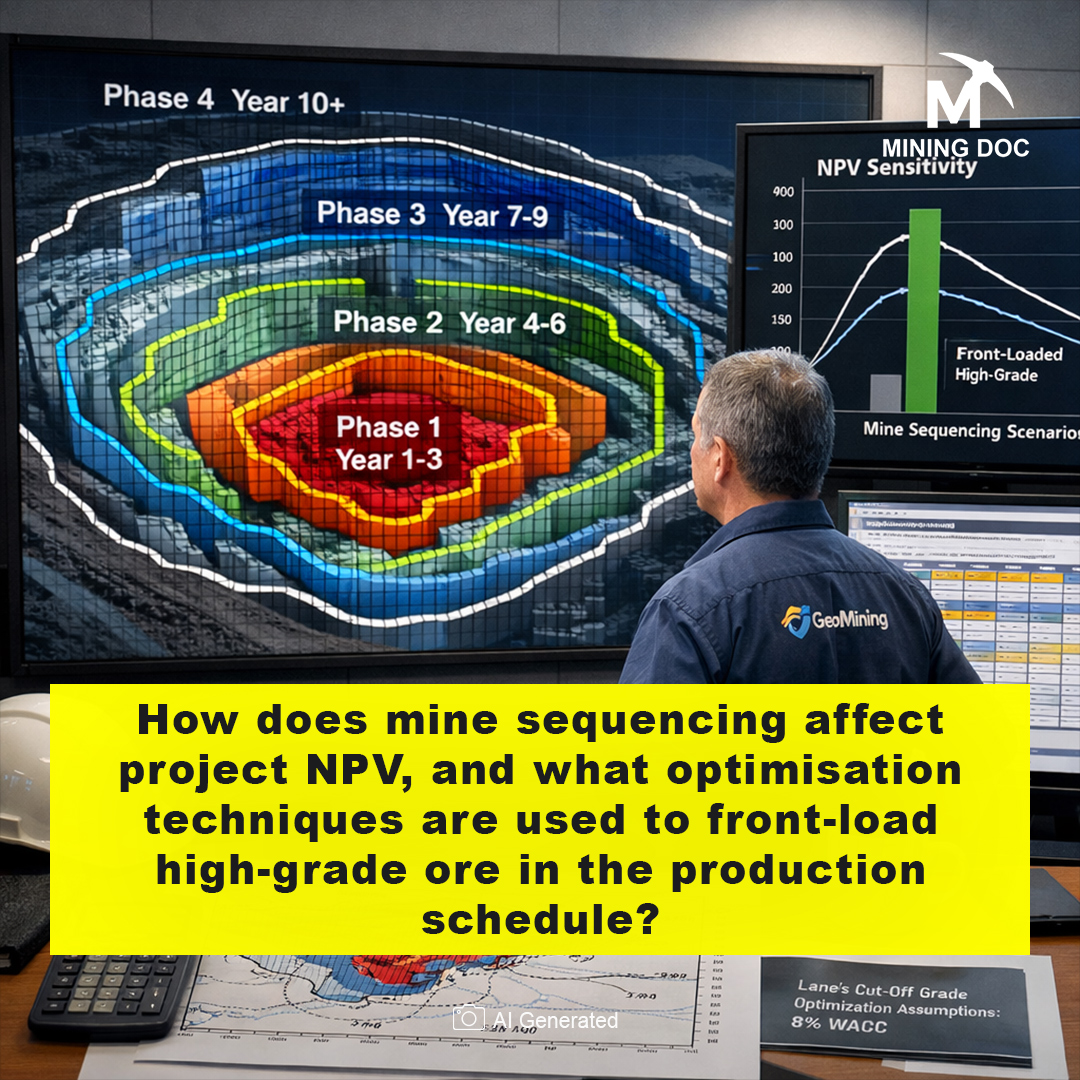
Mine sequencing and NPV are fundamental elements in mining engineering. Mine sequencing involves the planning of the spatial and temporal ordering of the removal of ore and waste blocks from a deposit. NPV involves determining the present value of all future cash flows from a project. It is important to comprehend the connection between these two elements when analyzing the economic feasibility of a mining project.
There is a significant relationship between mine sequencing and the NPV of a project. Production scheduling of an open pit mine involves the process of optimizing to get the highest possible NPV under certain constraints (Campos et al., 2018). As a result of the time value of money, cash flows earned during the first periods of a project are more valuable to its total NPV than cash flows earned after several years.
Mine planners adopt a principle of front-loading high-grade ore to ensure maximum gains from the mining venture. High-grade ore is the most valuable in terms of minerals and therefore front loading allows mine planners to recover their investment within a short period of time while avoiding future risks in terms of commodity price fluctuations.
There are several mathematical optimization methods that aid in the attainment of such a schedule. One of the common methods is the direct block scheduling (DBS). DBS models identify the optimal time for mining each three-dimensional block based on opportunity cost and time impact and thus overcome the problems with conventional pit nesting methods.
Modern sequencing techniques also apply stochastic optimization techniques to account for natural geological uncertainties that occur in the environment. Stochastic modeling, which employs geostatistical simulation techniques, seeks to schedule the extraction of high-grade ores while accounting for risk. Additionally, modern stochastic optimization techniques simultaneously seek to optimize the mine schedule and access infrastructure, such as ramps, to ensure the practicality of the optimized NPV (Cutler & Dimitrakopoulos, 2024).
In the end, intelligent sequencing of the mine is vital for a successful business operation. Through the use of advanced techniques such as direct block scheduling and stochastic programming, the operator can efficiently schedule the front-loading of high-grade ores.
References
Campos, P. H. A., Arroyo, C. E., & Morales, N. (2018). Application of optimized models through direct block scheduling in traditional mine planning. Journal of the Southern African Institute of Mining and Metallurgy, 118, 381–386. https://doi.org/10.17159/2411-9717/2018/v118n4a8
Cutler, J., & Dimitrakopoulos, R. (2024). Joint stochastic optimisation of open-pit mine production scheduling with ramp design. International Journal of Mining, Reclamation and Environment, 38, 480–495. https://doi.org/10.1080/17480930.2024.2335709