The mining industry is currently navigating a profound digital transformation, where traditional geological workflows are being redefined by Artificial Intelligence (AI) and Machine Learning (ML). This evolution is no longer a matter of luxury but a strategic necessity, driven by the imperative to synthesize massive datasets while mitigating the financial risks associated with geological uncertainty.
Precision in ore body modelling
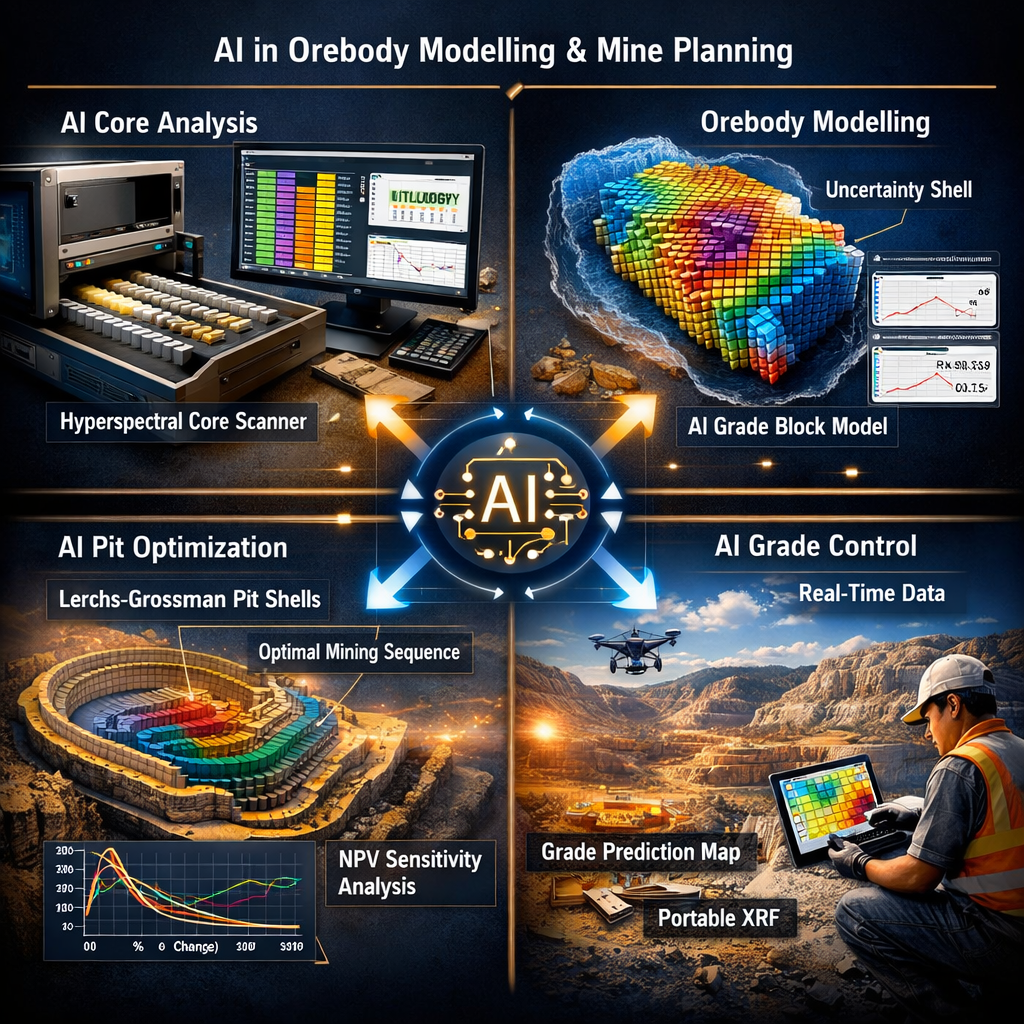
Historically, the industry relied on manual geological interpretations and linear geostatistical methods, such as ordinary kriging. While foundational, these techniques often struggle to capture the non-linear complexities of subsurface mineralogy. Today, AI bridges this gap by automating domain identification and ore classification with unprecedented accuracy (MathWorks, 2015).
Advanced supervised learning algorithms, including Support Vector Machines (SVM) and Random Forests, are now used to map spatial distributions by recognizing intricate patterns within multi-source data (Vayghan et al., 2024). Furthermore, the rise of Deep Learning (DL), specifically Convolutional Neural Networks (CNNs), has revolutionized mineral identification. These models can “see” anomalies in geochemical data and automate the analysis of drill core imagery, transforming raw visual data into actionable intelligence (Sun et al., 2024). By shifting toward these objective, data-driven frameworks, mining companies can significantly reduce the human-induced errors that historically led to resource valuation discrepancies of up to 30%.
Strategic mine planning and optimization
The utility of AI extends far beyond the geological model into the high-stakes arena of mine production scheduling. Designing an open-pit mine is a notorious “NP-hard” combinatorial challenge; calculating the perfect extraction sequence using traditional linear programming is computationally prohibitive (Loor & Morales, 2020).
To navigate this complexity, engineers employ Genetic Algorithms (GAs) and Metaheuristic Optimization. These tools mimic biological evolution, utilizing selection, crossover, and mutation, to iterate through thousands of potential pit designs and schedules. By combining K-means clustering with these algorithms, planners can develop robust “pushbacks” that align with geological constraints and operational realities, such as ramp width and equipment mobility. This precision ensures that the Net Present Value (NPV) is maximized while maintaining strict safety and logistical standards (Loor & Morales, 2020).
Conclusion
The integration of AI into mining marks a departure from speculative estimation toward a future of “Smart Mining.” By sharpening the accuracy of ore body models and streamlining the complexity of extraction schedules, AI fosters a more sustainable and economically resilient approach to global resource management.
References
He, L., Zhou, Y., & Zhang, C. (2024). Application of target detection based on deep learning in intelligent mineral identification. Minerals, 14(9), 873. https://doi.org/10.3390/min14090873
Loor, V., & Morales, N. (2020). Applying artificial intelligence for optimal production scheduling and phase design in open pit mining. MassMin 2020: Proceedings of the Eighth International Conference & Exhibition on Mass Mining, 1451-1466. https://doi.org/10.36487/acg_repo/2063_111
MathWorks. (2015). Maximise orebody value through the automation of resource model development using machine learning. Government of Western Australia, Department of Mines and Petroleum.
Sun, K., Chen, Y., Geng, G., Lu, Z., Zhang, W., Song, Z., Guan, J., Zhao, Y., & Zhang, Z. (2024). A review of mineral prospectivity mapping using deep learning. Minerals, 14(10), 1021. https://doi.org/10.3390/min14101021
Vayghan, A. G., Aliyari, F., Abedi, M., & Karami, M. (2024). Machine learning in smart mining: A systematic review of applications, algorithms, benefits, and challenges. Algorithms, 17(3), 114. https://doi.org/10.3390/a17030114