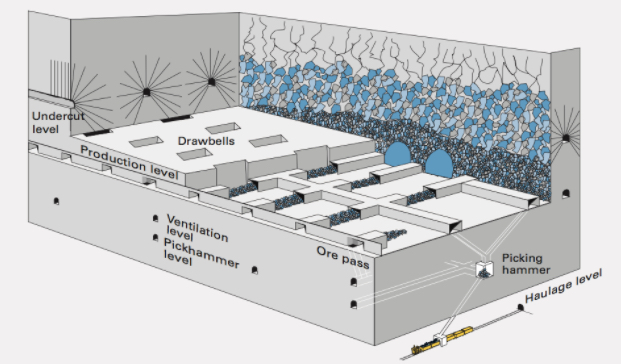
Block caving is an underground mass-mining method characterized by its reliance on natural gravitational forces to break and transport ore. Unlike selective mining methods that use extensive explosives to fragment every cubic meter of rock, block caving initiates a self-sustaining failure mechanism within the rock mass. This method is increasingly favoured for deep-seated, low-grade deposits due to its high production rates and low operating costs, which can approach the economic efficiency of open-pit mining.
How block caving works
The fundamental principle of block caving involves the “undercutting” of a massive block of ore. Engineers develop an extraction level consisting of a network of drifts and draw bells beneath the ore body. Once this infrastructure is in place, a horizontal slice of rock, the undercut, is blasted and removed. This creates a large, unsupported span that induces a state of instability.
Under the influence of in-situ stresses and gravity, the overlying rock mass begins to fracture and collapse into the void. As broken ore is removed through the drawpoints below, the “cave” propagates upward through the entire ore body. This continuous caving process persists until the capping rock (overburden) eventually reaches the surface, often resulting in a subsidence zone (Rafiee et al., 2015).
Ore body suitability and characteristics
Not every mineral deposit is a candidate for block caving. The success of the operation depends on specific geomechanical and geometrical parameters:
- Rock mass cavability: the most critical factor is the inherent ability of the rock to fracture and fail under its own weight. This is governed by the fracture frequency, joint orientation, and the presence of natural discontinuities. If the rock is too competent (strong and massive), the cave may stall, leading to dangerous “air blasts” or production stoppages (Brown, 2012).
- Deposit geometry: block caving requires a massive, relatively regular ore body with significant vertical and horizontal dimensions. The footprint must be large enough to exceed the “critical hydraulic radius,” ensuring the cave continues to propagate rather than arching and stabilizing (Rafiee et al., 2018).
- Ore value and distribution: because block caving is non-selective, it is best suited for disseminated mineralization where the grade is relatively uniform. Higher-grade ores are often preferred in the lower sections to offset the high initial capital expenditure (CAPEX) required for development (Moss, 2012).
- Ground stress and strength: There must be a delicate balance between the stress field and rock strength. While high stress helps propagate the cave, it can also threaten the stability of the extraction level drifts, requiring robust ground support systems (Jalali, 2011).
References
Brown, E. T. (2012). Block caving geomechanics. International Seminar on Block and Sublevel Caving.
Jalali, S. E. (2011). Reliability estimation of auxiliary ventilation systems in long tunnels during construction. Safety Science, 49(5), 664-669.
Moss, A. (2012). The transition from surface to underground mining. Mining Technology, 121(1), 1-2.
Rafiee, R., Ataei, M., Khalokakaie, R., Jalali, S. M. E., & Sereshki, F. (2015). Determination and assessment of parameters influencing rock mass cavability in block caving mines using the probabilistic rock engineering system. Rock Mechanics and Rock Engineering, 48(3), 1207-1220.
Rafiee, R., Ataei, M., KhalooKakaie, R., Jalali, S. E., Sereshki, F., & Noroozi, M. (2018). Numerical modeling of influence parameters in cavability of rock mass in block caving mines. International Journal of Rock Mechanics and Mining Sciences, 105, 22-27.