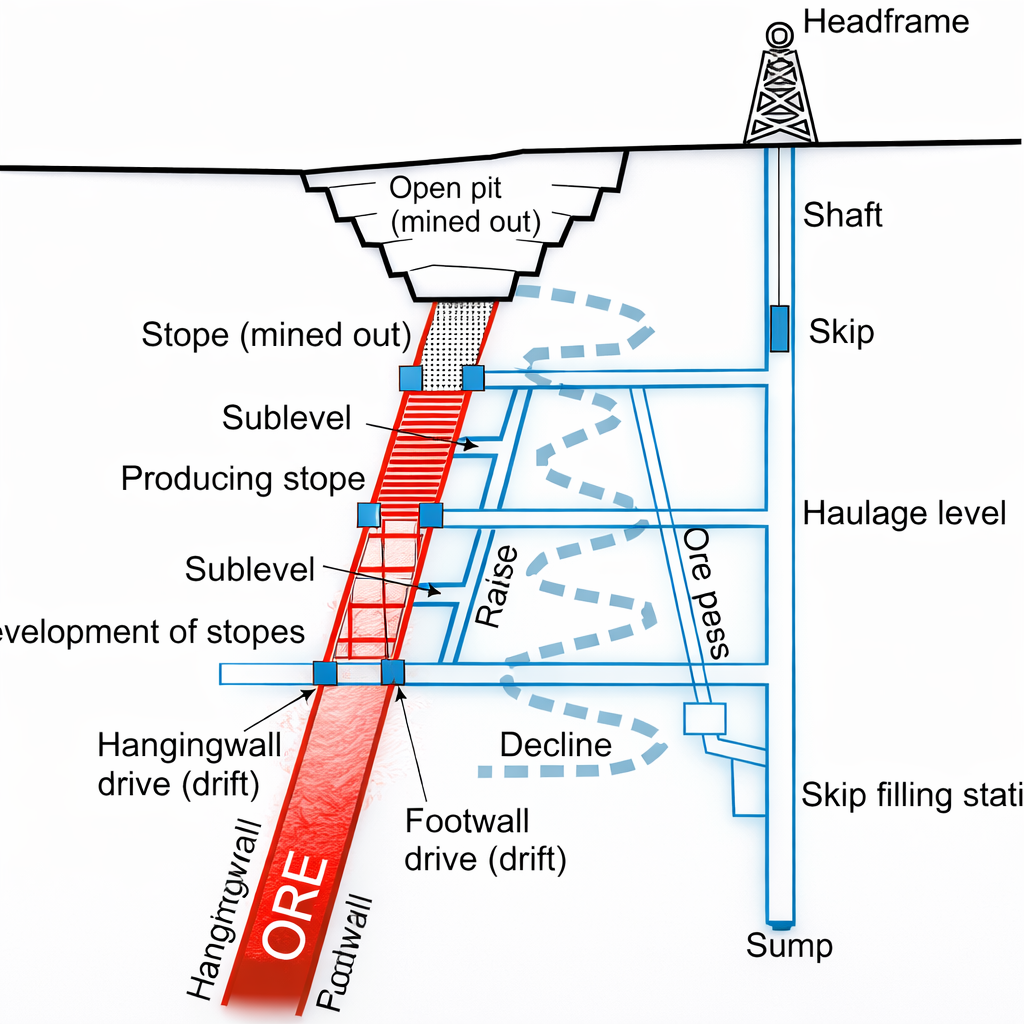
A decline in an underground mine should be designed around geometric, geotechnical, operational, and economic constraints so that it is safe, practical, and cost-effective over the mine life (Brazil et al., 2008). In practice, the best decline design balances truck access, rock stability, ventilation, and haulage efficiency from the start (Brazil et al., 2008).
Geometric requirements
The first issue is geometry. A decline must allow the safe movement of trucks and equipment, so the gradient and turning radius must stay within vehicle limits (Brazil et al., 2008). The alignment should also avoid unnecessary bends and excessive length, because every extra metre increases development and haulage costs (Brazil et al., 2008). Where possible, designers use path-optimisation methods to reduce travel distance while still respecting physical constraints (Brazil et al., 2008).
Geotechnical stability
Rock mass conditions are a second major consideration. The decline must be placed in ground that can remain stable under excavation and long-term traffic loading, especially in areas of stress concentration, faulting, or weak rock (Brazil et al., 2008). Wall support, stand-off distance from ore zones, and intersection angles at crosscuts should be planned to reduce deformation and failure risk (Brazil et al., 2008). Good geotechnical design also helps limit rehabilitation costs and downtime later in the mine life.
Ventilation and services
A decline is not only a haul road; it is also an access corridor for services. Its layout should support ventilation flow, power, water, communication lines, and emergency egress without obstructing traffic or future extensions. This means the decline must be planned together with the overall mine infrastructure, not treated as an isolated tunnel. A poor location can create bottlenecks for both production and safety systems.
Mine life economics
The final consideration is economic performance. The decline should be designed to minimize total life-of-mine cost, not only initial development cost. That includes development metres, operating haulage distance, fuel use, maintenance, and future access to stopes or production areas (Brazil et al., 2008). For shallow to moderate-depth mines, decline access can be especially attractive because it may reduce upfront capital and simplify production access.
Conclusion
A well-designed decline is a compromise between engineering limits and mine economics. The most effective design is one that is safe, stable, maintainable, and efficient for haulage and services throughout the mine life (Brazil et al., 2008).
Reference
Brazil, M., Grossman, P. A., Lee, D. H., Rubinstein, J. H., Thomas, D. A., & Wormald, N. C. (2008). Decline design in underground mines using constrained path optimisation. Mining Technology: Transactions of the Institutions of Mining and Metallurgy, 117(2). https://doi.org/10.1179/174328608X362668