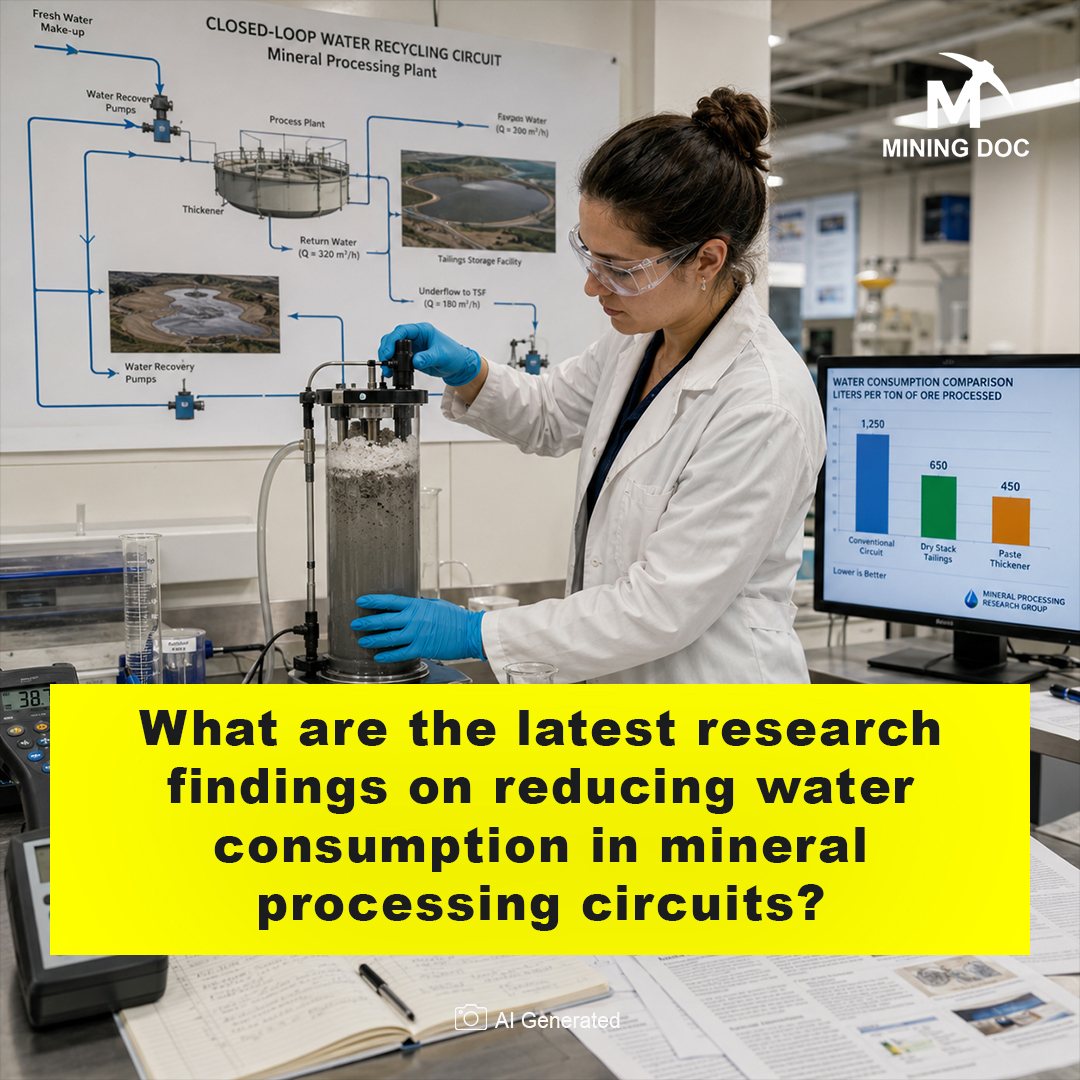
New studies focus on novel ways of reducing water consumption in mineral processing plants, emphasizing water recirculation, dry processing, and technological advancements amid growing worldwide mineral demand. The studies underscore the importance of sustainable practices for water-intensive mineral processing operations in water-scarce regions, such as mining centers in Africa and Chile. Innovations have focused primarily on reducing water loss during grinding, flotation, and dewatering operations.
In the case of Chile, new research indicates that the demand for mineral processing water will increase to 78% of total water use in mining operations by 2032. Consequently, 74% recirculation and 0.52 m³ of additional water use per ore ton will be required by 2020. Water savings through modeling can be achieved based on factors internal to the system, including tailing particle size and solid content.
Dry processes utilize air separation techniques rather than water-intensive ones, thus drastically reducing water usage during ore crushing and sorting stages. These techniques have been identified by Atlas Copco as appropriate for some specific types of ores without using wet grinding at all. In combination with desalination or recycled water, dry processes help to minimize the dependence on fresh water in areas where it is scarce.
Water pumps account for 18-28% of total plant power usage and 7% of site water usage in gold mining, copper mining, and iron mining facilities. Proper pump selection that takes into account cumulative effects allows one to select more efficient pumps without over-protection and unnecessary consumption.
Optimized filtration reduces water consumption by as much as 90% through enhanced dewatering. Roxia emphasizes filtration solutions that quicken thickening and increase recycle rates. Advanced sensors detect blockages in order to keep solids output high while reducing the need for flush water.
Circular models are explored by studies seeking reductions in water use through process modifications like using HPGRs instead of ball mills to save on water requirements. LCA results reveal that recycling minimizes expenses both economically and environmentally, although achieving zero discharge proves difficult. Microorganisms eliminate toxic contaminants from wastewater for reuse.
At least by 2026, operations will achieve efficiency levels of 85-95% as a result of recirculation and AI-powered systems. Good practice consists of a combination of rainwater harvesting, constructed wetlands, and complete closed loop system operation. African operations, considering user knowledge, will require similar efforts due to geological conditions and predictive maintenance to reduce leaking.