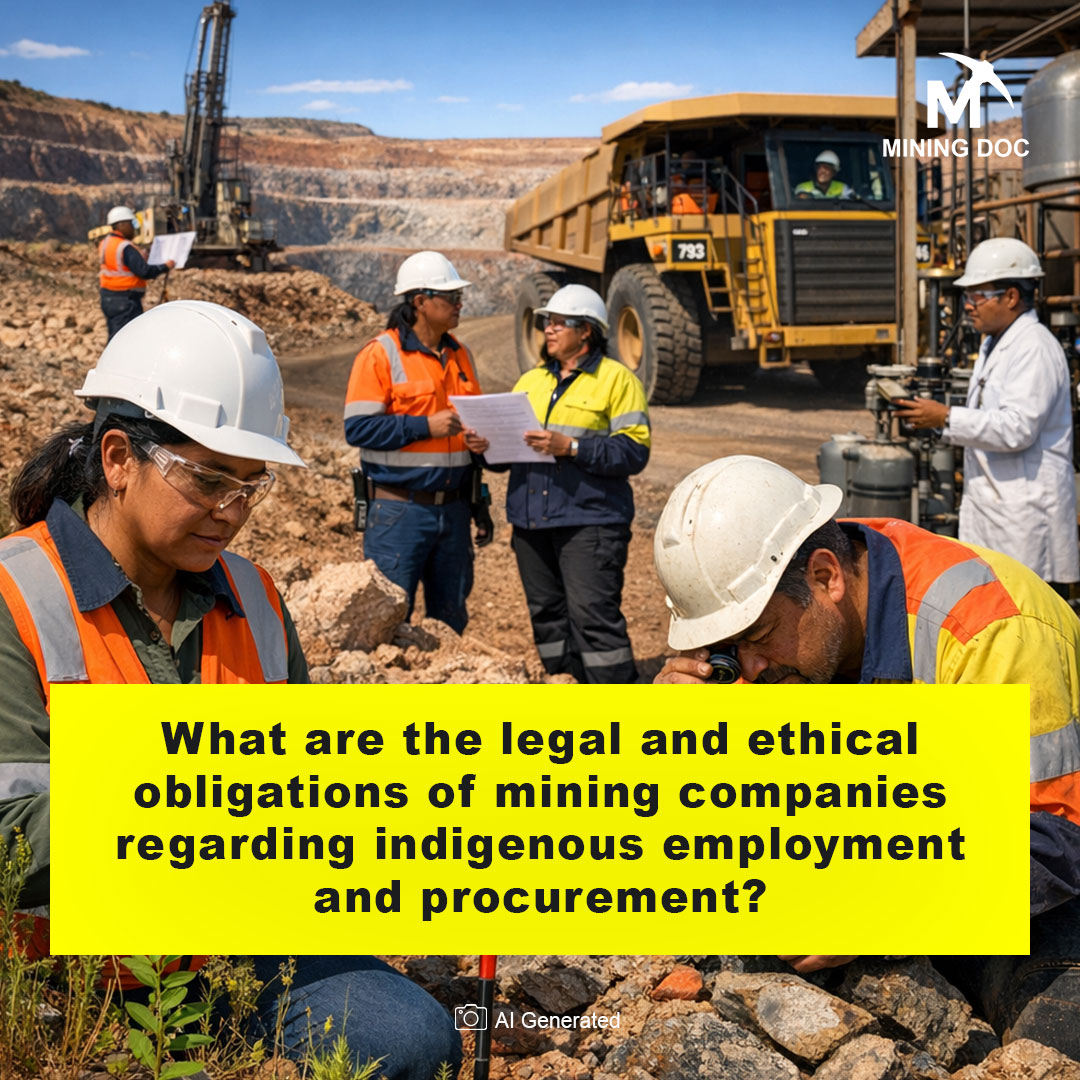
Legal and ethical obligations toward Indigenous peoples’ rights in recruitment and procurement exist beyond merely meeting certain quotas and sourcing locally. Indeed, companies have to refrain from discriminatory practices, engage in good-faith consultations, obtain consent in cases where indigenous territories and their rights are at stake, and foster economic engagement via employment, contracting, and suppliers.
Firstly, there is an established legal duty derived from international principles of human rights and national legislation concerning land, cultural and historical heritage, and consultation in many countries.
As reported by ICMM, the mining company must recognize the rights of indigenous communities through its due diligence regarding human rights, consultation, and, when necessary, seeking consent in relation to impacts on these rights, as well as follow the legislation.
Where national law is lacking, it urges companies to pursue a higher standard, even if they remain compliant with the applicable legislation. Finally, the United Nations Permanent Forum on Indigenous Issues emphasized that any project being undertaken on the territory of indigenous people requires their consent.
Secondly, employment obligations concern not only equitable access to employment, but rather removing the barriers that have historically prevented Indigenous peoples from participating in the workforce. As highlighted by the CSRM report on the Australian minerals industry, the creation of sustainable Indigenous employment involves executive-level commitment, truthful engagement with Indigenous communities, culturally-aware recruitment, mentorship, flexible rostering, and combating issues of racism and poor retention rates. From an ethical perspective, this entails that companies must not only provide employment opportunities, but also actively facilitate Indigenous participation through training and readiness programs.
Thirdly, obligations related to procurement involve providing Indigenous business opportunities through concrete actions and not tokenistic gestures. In relation to the latter, Mining Shared Value states that the objective of its indigenous procurement checklist is to aid in developing procurement strategies that benefit Indigenous-owned businesses and measure against best practices. In the same vein, Canadian guidance highlights that procurement is also a matter of respecting Indigenous peoples’ rights, meaningful engagement, capacity building, and economic development.
Fourthly, ethical procurement needs to be transparent, competitive, build capacity, and ensure follow-up. According to ICMM, benefit sharing should be consistent with the aspirations of Indigenous peoples for socio-economic development. In addition, engagement should be done through indigenous governance structures with adequate support being provided by companies to enable communities to engage fairly in negotiations. Further, Mining Shared Value argues that transparency and clarity of the procurement process would aid in overcoming the problems of opacity in reporting.
Lastly, corporations need to consider indigenous hiring and procurement as their responsibility in avoiding causing any harm or providing benefits to Indigenous peoples during the project lifecycle. First, ICMM requires companies to undertake due diligence both initially and throughout the project lifecycle, agreements when appropriate, and remediation if the company causes rights infringements or participates in causing them. Second, CSRM found out that when companies consider indigenous employment as a corporate activity rather than an informal activity or promise, they have more success.
The final ethical criterion is above minimum legal requirements, and mining companies must strive to partner, self-determine, and create sustainable wealth within the community. The debate on 2025 by the United Nations set forth that responsibility in mining was dependent upon Indigenous Peoples being allowed a place at the table due to the importance of obtaining consent in terms of morality, law, and minimizing conflicts. To state simply, the ideal approach would be to employ, purchase, and invest in such a manner that promotes Indigenous self-determination rather than mining rights.