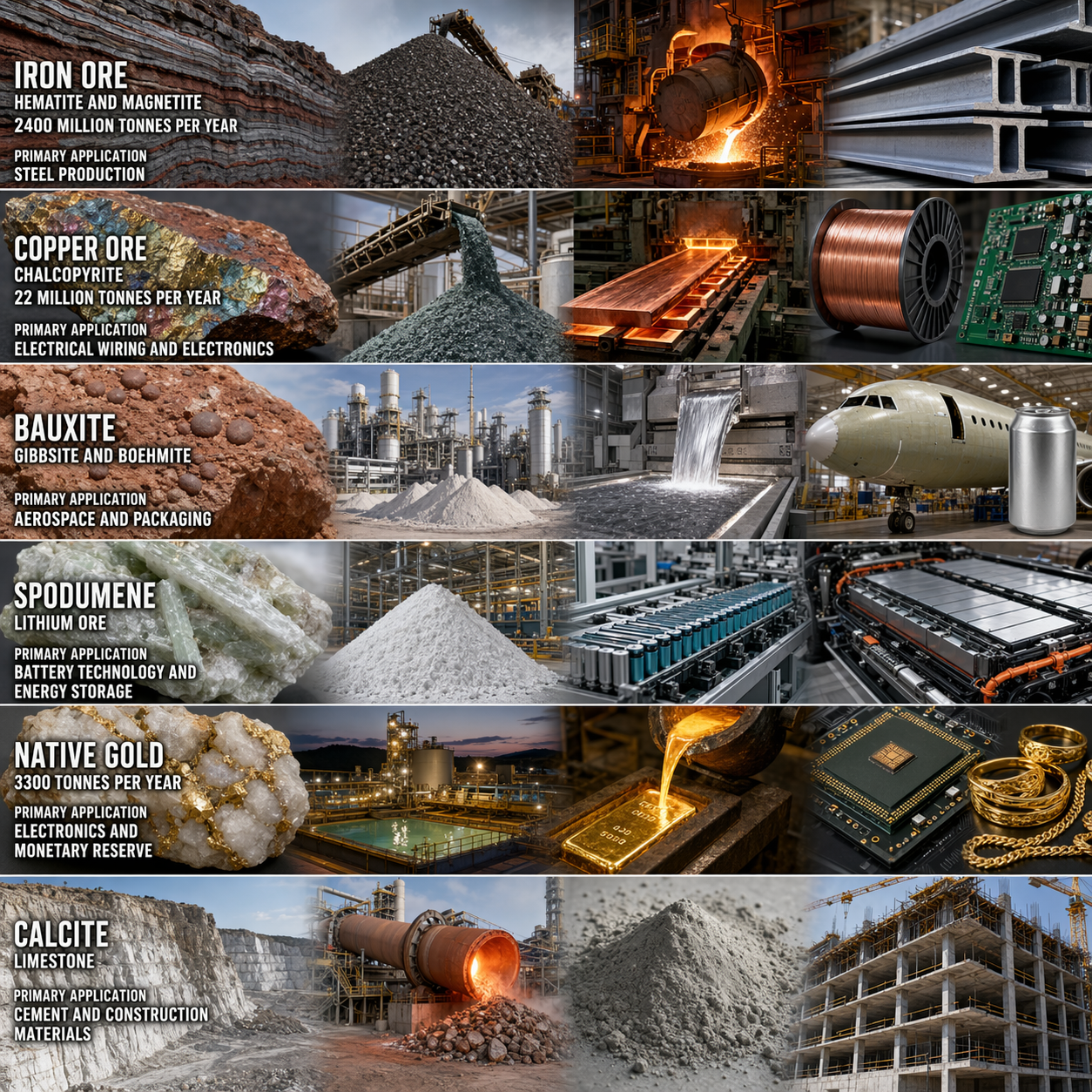
The extraction of minerals serves as the structural foundation of the global economy, providing the raw materials essential for infrastructure, technology, and energy systems. While thousands of mineral species exist, a select group of metallic ores and industrial minerals dominates global production due to their versatile physical and chemical properties. According to the U.S. Geological Survey (2025), global mining efforts are increasingly focused on both high-volume bulk commodities and high-value critical minerals necessary for the green energy transition.
The table below summarizes the most common minerals and their primary industrial applications.
|
Mineral/Raw Material |
Annual Production (Approx.) |
Primary Industrial Applications |
|
Construction Aggregates (Sand, Gravel, Crushed Stone) |
> 48 billion metric tons (est.) |
Primary ingredient in concrete for buildings and roads; used as fill for foundations and as asphalt for paving. |
|
Limestone |
> 6.5 billion metric tons (est.) |
Key ingredient in cement production; flux in steelmaking; soil conditioner in agriculture; water treatment and flue gas desulfurization. |
|
Coal |
7.9 billion metric tons |
Fuel for electricity generation; key ingredient in steel production (as metallurgical coke). |
|
Iron Ore |
2.4 billion metric tons |
Primary raw material for manufacturing steel, which is used in construction, transportation (ships, cars), and machinery. |
|
Bauxite (Aluminum Ore) |
294 million metric tons |
Refined into alumina and then smelted to produce aluminum metal, used in packaging (cans), transportation, and construction. |
|
Phosphate Rock |
261 million metric tons |
Primarily used to produce phosphate fertilizers, which are essential for global food production. Also used in animal feed. |
|
Potash |
40.4 million metric tons |
Main source of potassium for fertilizers, helping to improve crop yield and quality. |
|
Copper |
20 million metric tons |
Electrical wiring and cables; plumbing pipes; construction materials; industrial machinery. |
The unseen giants: construction materials
While metals often dominate the news, the most extracted minerals by volume are the ones that build our physical environment.
- Sand, Gravel, and Crushed Stone: these materials are the foundation of modern infrastructure. They are the main components of concrete and asphalt, used in everything from home foundations to highways and airports. Their value is relatively low, so they are typically mined close to where they are used to keep transportation costs manageable.
- Limestone: this versatile rock is a critical ingredient in cement, which binds concrete together. It also plays a vital role in the steel industry as a flux to remove impurities and is used in agriculture to reduce soil acidity.
Mining Doc hope this overview helps clarify the different types of minerals that are most mined and how they are used in daily life and industry. If you are interested in a specific mineral or application, feel free to ask for more details.