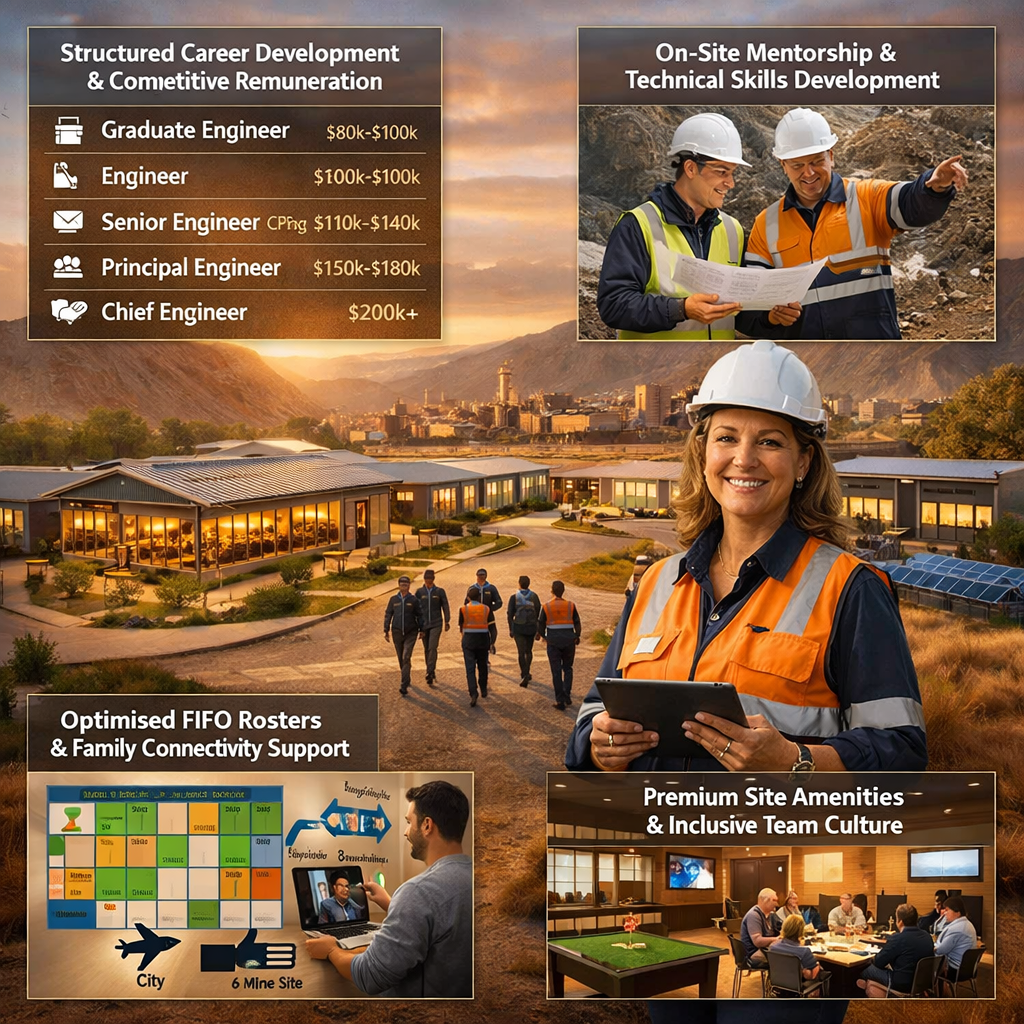
The best approach involves the combination of good working conditions, good camp life and career progression, to ensure that the engineer perceives the remote location as livable and rewarding from a professional perspective. Following are six highly relevant levers identified by literature and industry insights for the recruitment of remote mine engineers.
Start by designing a compelling employee value proposition (EVP). The EVP should explain the advantages of working at a remote mine over an office-based position by highlighting aspects like dealing with complex orebodies, automation projects, accelerated progression of responsibilities and prospects of becoming a superintendent or entering technical departments of the company. Specialized recruiting agencies for the mining sector stress that one must start every hiring process with a clear EVP and advertise the position in specialized networks of professionals, FIFO databases, and STEM communities instead of generic job websites, since such an approach targets applicants who are inclined to remote jobs and minimizes initial turnover. As far as hard-to-fill positions (such as process control, maintenance reliability, mine planning) go, companies which openly describe their rosters, and site conditions have better acceptance and retention figures.
Second, develop rosters, travel, and camp living experiences that promote well-being and connections with one’s family. Guidance on remote mining talent attraction issued recently points out that rostering has emerged as the key make-or-break element, and rosters like 2:2 or 8:6 are vastly more appealing than traditional roster systems that have proven more tiring for employees. Firms are also increasingly offering additional features in the form of leave loading and shorter rosters for certain jobs as well as charter travel plans to minimize fatigue while travelling. On site, quality accommodation – comfortable living space, great catering, good communication links, recreation areas, and health services – has become a basic need rather than a perk.
Third, provide competitive and transparent remuneration that includes retention bonuses based on site time. From mining personnel analysis, one can note that engineers always compare their salaries against global standards, especially FIFO and expatriate roles. Thus, it would be wise for recruiters to ensure that the base salary offered is competitive not only against local salaries but also in engineering hotbeds such as Australia and Canada. Dividing packages into base salary, remote allowance, site condition allowance, travel days, and roaster bonus ensures that all components are accounted for and make the overall package easy to compare. This way, there will be fewer dropouts when considering competing offers. There is also the need for other levers of retention such as completion bonuses, long-term incentive plans, and educational benefits (e.g., pursuing chartered status or an MSc while working).
Fourth, make career development and challenge key retention factors, not afterthoughts. Career-retention research in engineering highlights how a disproportionately large percentage of employees indicate that they would have stayed for a longer time had there been a direct investment in their careers, with engineers especially preferring clear advancement prospects and development talks. The complexity at a remote mine can be leveraged by offering challenging projects, such as automation initiatives, debottlenecking activities, and new pit developments, as well as providing decision-making freedom along with rotational opportunities between planning, operations, and projects roles to develop skills quickly. Having a separate budget for training, access to cutting-edge software, and exposure to internal speaking engagements and mentoring positions ensures that the employee sees the remote assignment as an important step in his or her career.
Furthermore, make sure to foster a healthy safety culture to mitigate the psychological negative effects of remoteness. Recruitment professionals advise that companies screen candidates for their capacity to adapt to challenging environments and a mindset focused on safety, as difficult living conditions, remoteness, and limited amenities may increase psychological pressure and pose additional risks. Companies that provide communication channels and regular check-ins of their HR managers with employees working remotely claim higher productivity levels of their staff due to prompt problem-solving before problems arise. Proper alignment of managers regarding inclusiveness, zero tolerance of inappropriate behavior within camps, and their personal appearance onsite will help engineers to feel appreciated and listened to, regardless of their salaries.
Lastly, utilize specialist partners and flexible working arrangements if possible in order to gain access to rare skills or accommodate dual-career or family obligations. Sector-specific workforces that have worldwide networks may be able to find engineers with experience working on-site remotely and understand what the reality of life in such conditions entails, thus helping to prevent high turnover rates in the early stages and ensuring that employees get up-and-running in time to complete their job. For certain senior-level technical and managerial positions, partial hybrid working arrangements (such as working remotely on planning days while based out of an office in a capital city on an alternating swing basis) or rostering arrangements may alleviate stress, making the position more manageable over several years.