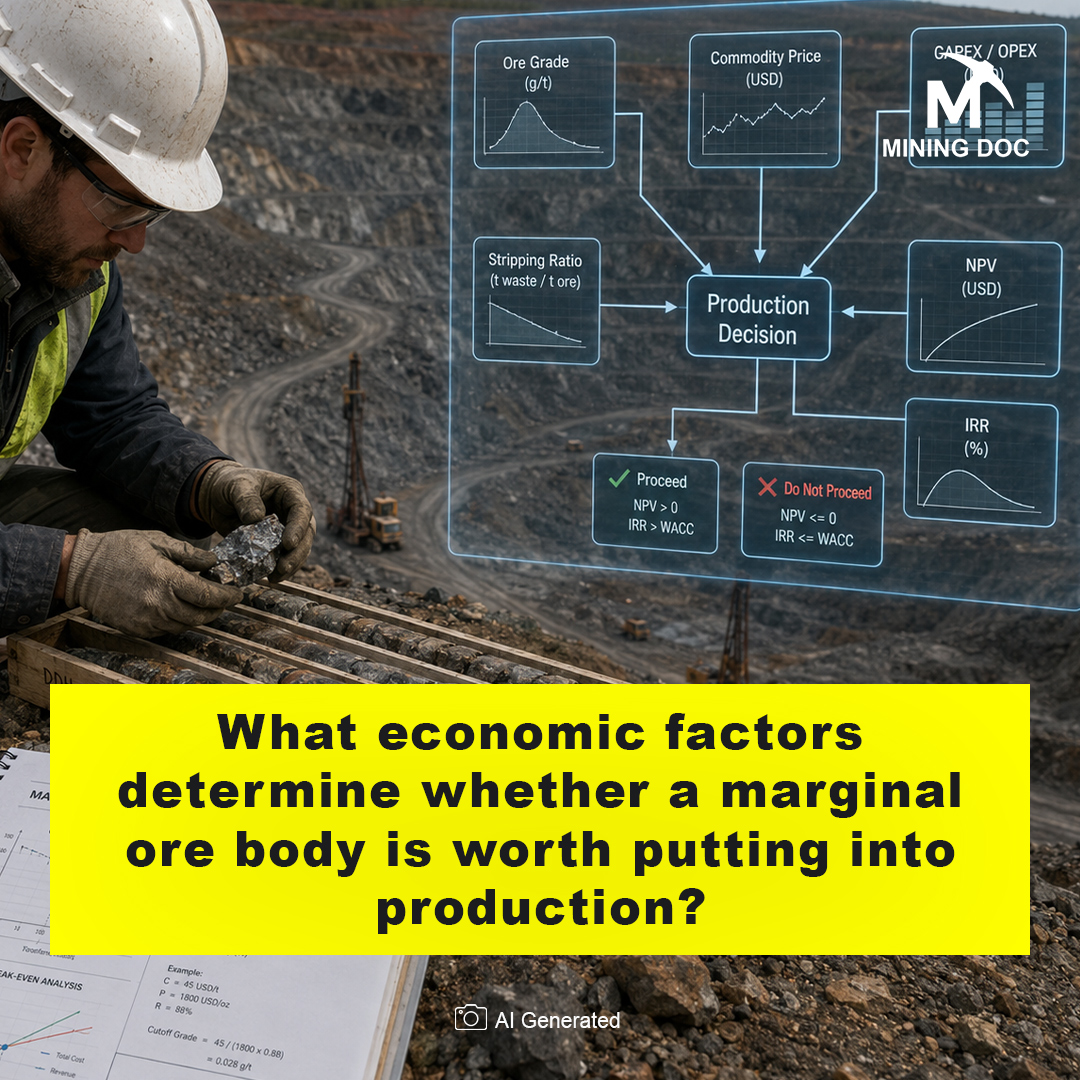
For an ore body to be produced, there needs to be enough profitability after taking into consideration the cost of extraction and processing of the ore, where there is a positive cash flow even though profit may be small. Price of the product is the main determinant because an increase in price makes the ore economically viable at grades that are too low before, allowing the company to incur more external costs such as transportation.
It is important to note that ore grade and recovery ratio are the most significant factors since they determine the quantity of saleable metal that can be produced from the tons of rocks mined. With low-grade ore bodies, more quantities need to be mined in order to produce the same amount of metal, leading to an increased requirement for energy and chemicals used for comminution processes.
Mining and milling costs include CAPEX for facilities, as well as OPEX for labor, power consumption, and other supplies. Selection of the mining technique (open pit vs underground), which depends on the characteristics of the deposit, such as its depth and geometry, as well as the stripping ratio of waste rocks to ore, significantly impacts the costs. It is relatively inexpensive to exploit shallow deposits, whereas deeper ones can only be mined by the underground method. Proper cost calculation at all stages is crucial.
The scale of operations and production rates impact the feasibility of projects due to economies of scale and the flow of the cash. Large-scale operations necessitate significant investment but produce annual positive cash flow, while small-scale operations necessitate less investment but take longer to pay off annually. Too low a production rate will result in insufficient annual cash flows to cover investment, while too high a production rate may entail excessive capital expenditure in light of the region’s infrastructure.
Net present value (NPV) of a project will either be negative or positive based on financial measures and the appropriate discount rates. Ore grades affect the NPV by defining the amount of precious metal in relation to waste material. The projects need to make enough cash to meet the necessary rate of return to cover the time value of money. Cutoff grades are used as a mechanism to manipulate the minimum acceptable ore grade for balancing cash flows and mine life in an uncertain market.
External factors such as royalties, taxes, availability of infrastructures, and completeness of market demand are some of the considerations made towards final decision making. The royalties that depend on the nature of the ore deposits make up part of the cost of mining. Demand for metal products in the industrializing countries such as India and China makes the prices high but the substitutes or low-cost metals decrease the demand.