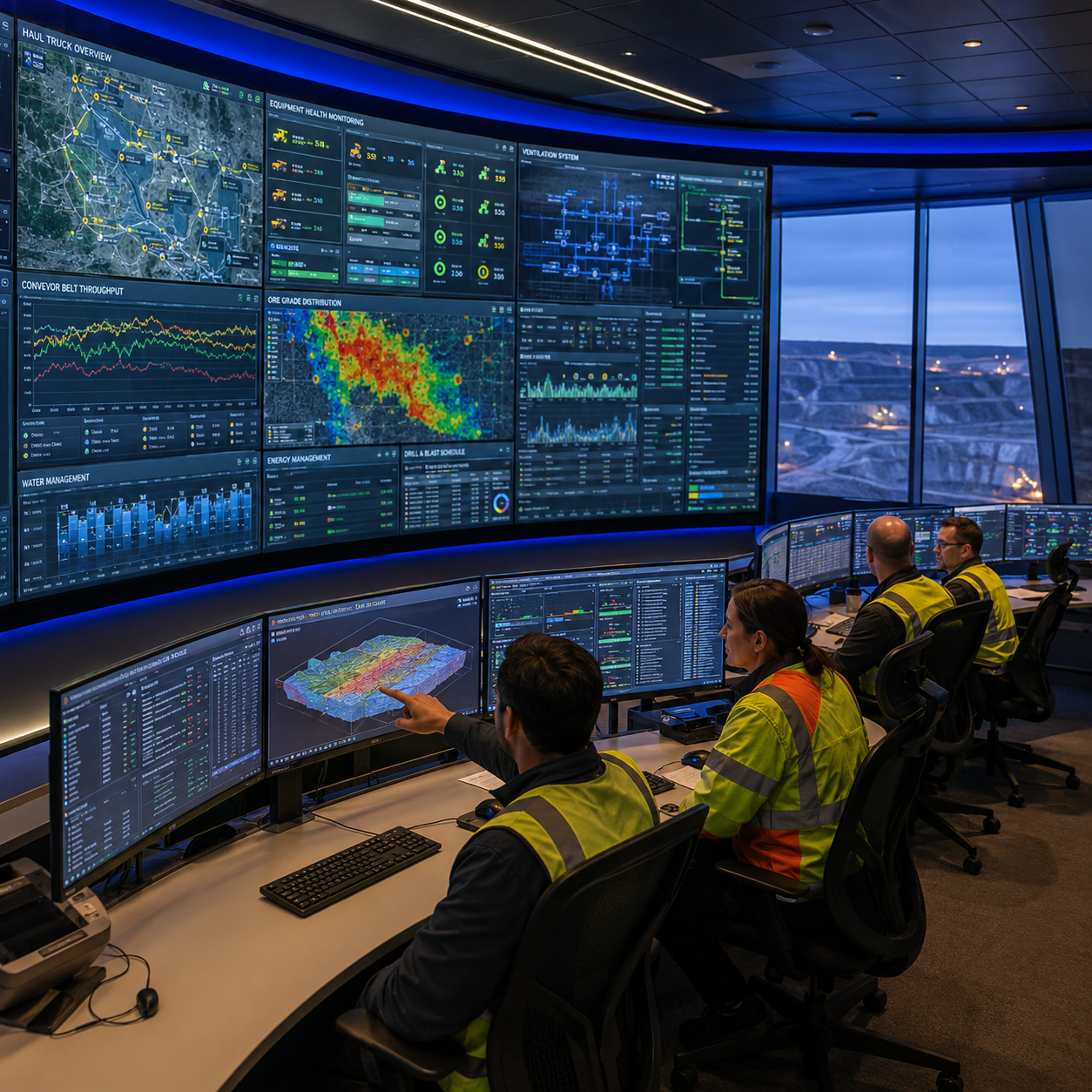
An Integrated Operations Centre (IOC) refers to a facility where human elements, equipment data, and operation systems have been merged to enable effective monitoring and coordination of all activities within a mining environment. Simply put, it is not just the conventional control room but involves a blend of visualization, analysis, planning, scheduling, and operation management.
In a typical setting, an IOC will gather all kinds of data from different sources including fleet management systems, plant operations, communication systems, tracking of personnel, maintenance operations, and sensors among other things. The collected data is analyzed to generate operational information that can be accessed and used by dispatchers, supervisors, engineering, and technical teams. With well-developed IOC, coordination and even orchestration of operations in different fields including mining, processing, maintenance, logistics, and safety becomes feasible.
Decision-making is faster and of better quality since the IOC gives real-time information about activities taking place in mines. Teams will be able to identify potential problems and handle them without waiting until they have caused significant losses. This method will also eliminate time delays brought about by fragmented data collection because the management team will be able to make decisions based on information collected without waiting for reports from other departments. In a nutshell, the IOC allows organizations to move from being reactive to proactive with their operations.
The greatest strength of real-time control in an IOC lies in its ability to manage the execution of activities in the mining industry. For instance, in the case of Venetia Underground, the IOC was referred to as the center of operations management since it collected, analyzed, and relayed information back to the underground employees. Such a system enables supervisors to change priorities for shifts, manage equipment, and issue early warnings for any problems that may come up in the process.
IOCs enhance safety through constant monitoring of hazards, worker locations, and equipment status. If a mine is able to observe what is happening in terms of locations of people and machines, it will be able to react promptly to incidents caused by collisions, geotechnical events, ventilation problems, or emergencies. In terms of maintenance, real-time data about the operations of equipment can also serve as a basis for predictive maintenance, since abnormal behavior can be detected early on, thus preventing equipment failures.
An IOC should be based on a certain reason for its implementation and well-defined accountability. The success of an implementation is usually defined by the decision that needs to be made regarding the type of IOC being created – whether it serves purposes of control, collaboration, or coordination. Organizations also tend to base their implementations on the data that is available to them at the time and make improvements gradually. Without implementing such operating discipline, the IOC will remain nothing more than a room full of screens.
Mines use IOCs due to their ability to enhance productivity, minimize downtime, enhance transparency, and create safer working environments. IOCs are more important when there is the need to synchronize production, maintenance, logistics, and safety at very short intervals, like underground mines and highly mechanized mines. In summary, an IOC provides an effective way of making decisions in real time by integrating information from the various aspects of mining into a cohesive unit.