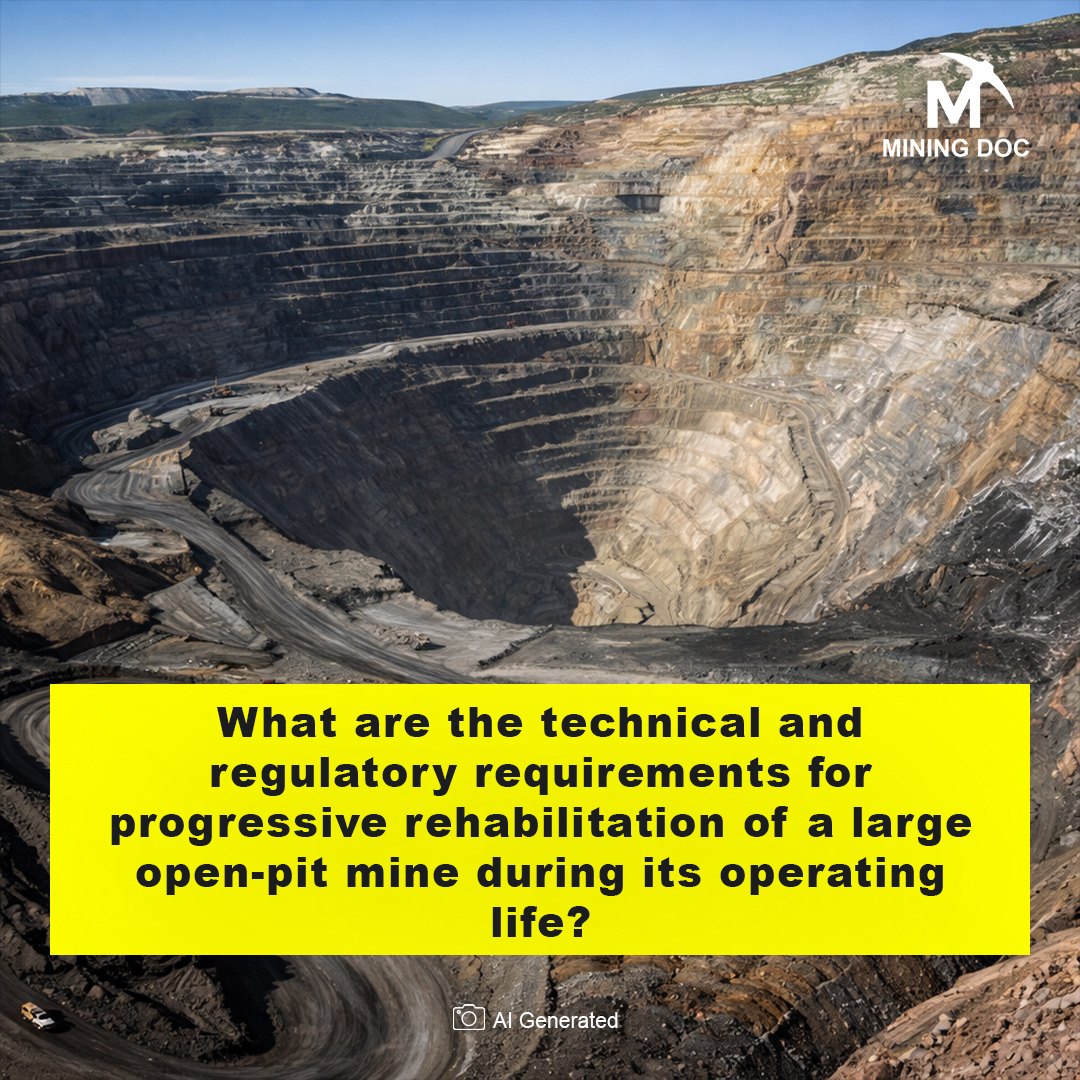
Large scale open pit mining results in considerable land disturbance to mine for minerals in surface level. The progressive rehabilitation is the process of returning the disturbed land into a sustainable state of being safe and stable throughout the life of the mine instead of doing so after the extraction is complete. This technique helps minimize disturbance of the mine during its operation and promotes rapid ecological recovery (Lechner et al., 2016).
The regulatory frameworks have put it down as a responsibility on the mining companies to ensure the inclusion of progressive rehabilitation in the strategic plan prior to the extraction process. Current legislative frameworks consider mining a temporary land use and therefore call for the need of developing detailed closure plans with consideration of the environmental and socio-economic factors (Oliveros-Sepúlveda et al., 2025).
A key regulatory requirement in the process of restoration is the determination of the completion criteria. These are site specific and measurable performance criteria developed between the operator and regulators and determine the ability of the rehabilitated area to fulfill its designated post-mining land use (Manero et al., 2020). Setting realistic goals at the very beginning would help comply with regulations and eventually remove financial liabilities and prepare for formal relinquishment of the land.
Technologically, progressive rehabilitation requires sound management of both geotechnical and hydrologic aspects. Open pit mining involves producing large amounts of waste rock and overburden, which must be systematically backfilled and contoured to provide physical stability. Landforms should be designed not only to ensure geotechnical safety but also avoid geochemical contamination.
Ecological technical prerequisites are equally important. There should be the reconstitution of topsoil, hydrological system restoration, and planting of native species to restore functional ecosystems. Modern spatial monitoring technologies, involving, for instance, the use of drones to monitor the process of vegetation growth and subsidence of land (Lechner et al., 2016), have been gaining popularity. Continuous intervention helps achieve gradual restoration of an ecologically stable condition of the disturbed territory.
In conclusion, successful rehabilitation of large open pit mining involves the flawless combination of regulation and complex technical implementation. Focusing on specific criteria for completion of work (Manero et al., 2020) and accounting for recovery costs when planning (Oliveros-Sepúlveda et al., 2025), one can avoid environmental harm.
References
Lechner, A. M., Kassulke, O., & Unger, C. (2016). Spatial assessment of open cut coal mining progressive rehabilitation to support the monitoring of rehabilitation liabilities. Resources Policy, 50, 234–243. https://doi.org/10.1016/j.resourpol.2016.10.009
Manero, A., Kragt, M., Standish, R., Miller, B., Jasper, D., Boggs, G., & Young, R. (2020). A framework for developing completion criteria for mine closure and rehabilitation. Journal of Environmental Management, 273, 111078. https://doi.org/10.1016/j.jenvman.2020.111078
Oliveros-Sepúlveda, D., Bascompta-Massanés, M., & Franco-Sepúlveda, G. (2025). Environmental and closure costs in strategic mine planning, models, regulations, and policies. Resources, 14(3), 41. https://doi.org/10.3390/resources14030041