Sign In


Forgot Password?

Don't have account, Sign Up Here

Forgot Password

Lost your password? Please enter your email address. You will receive a link and will create a new password via email.


Have an account? Sign In Now

Sorry, you do not have permission to Add a Post, You must login to Add a Post.


Forgot Password?

Need An Account, Sign Up Here

Sorry, you do not have permission to add Article.


Forgot Password?

Need An Account, Sign Up Here

Please briefly explain why you feel this Post should be reported.

Please briefly explain why you feel this Comment should be reported.

Please briefly explain why you feel this user should be reported.

Mining Doc Logo Mining Doc Logo Mining Doc Logo
Sign InSign Up

Mining Doc

Mining Doc Navigation

  • Home
    • About
    • Contact us
  • Mining articles
  • Online Courses
Search
Sign up

Mobile menu

Close
join for free
  • Home
  • Online courses
  • Case study
  • Mining Community
  • Solutions listing
    • Lase Solutions
    • O-PitBlast Solutions
    • Continuous Mining
    • Longwall mining
    • Geosight Scanners
    • LoopX AI
    • Terafil solutions
    • Blasting solutions
    • Geotechnical
    • Submersible Pumps
    • Mine rescue system
    • Ore sorting
    • Whittle Consulting Solutions
  • Add Blog
  • Feed
  • User Profile
  • Posts
    • New Posts
    • Trending Posts
    • Must read Posts
    • Hot Posts
  • Polls
  • Badges
  • Home
    • About
    • Contact us
  • Mining articles
  • Online Courses

Mining Doc Latest Posts

Mining Doc
  • 0
  • 0
Mining DocBeginner
Added: May 14, 20262026-05-14T04:35:05-04:00 2026-05-14T04:35:05-04:00In: Mining Sustainability

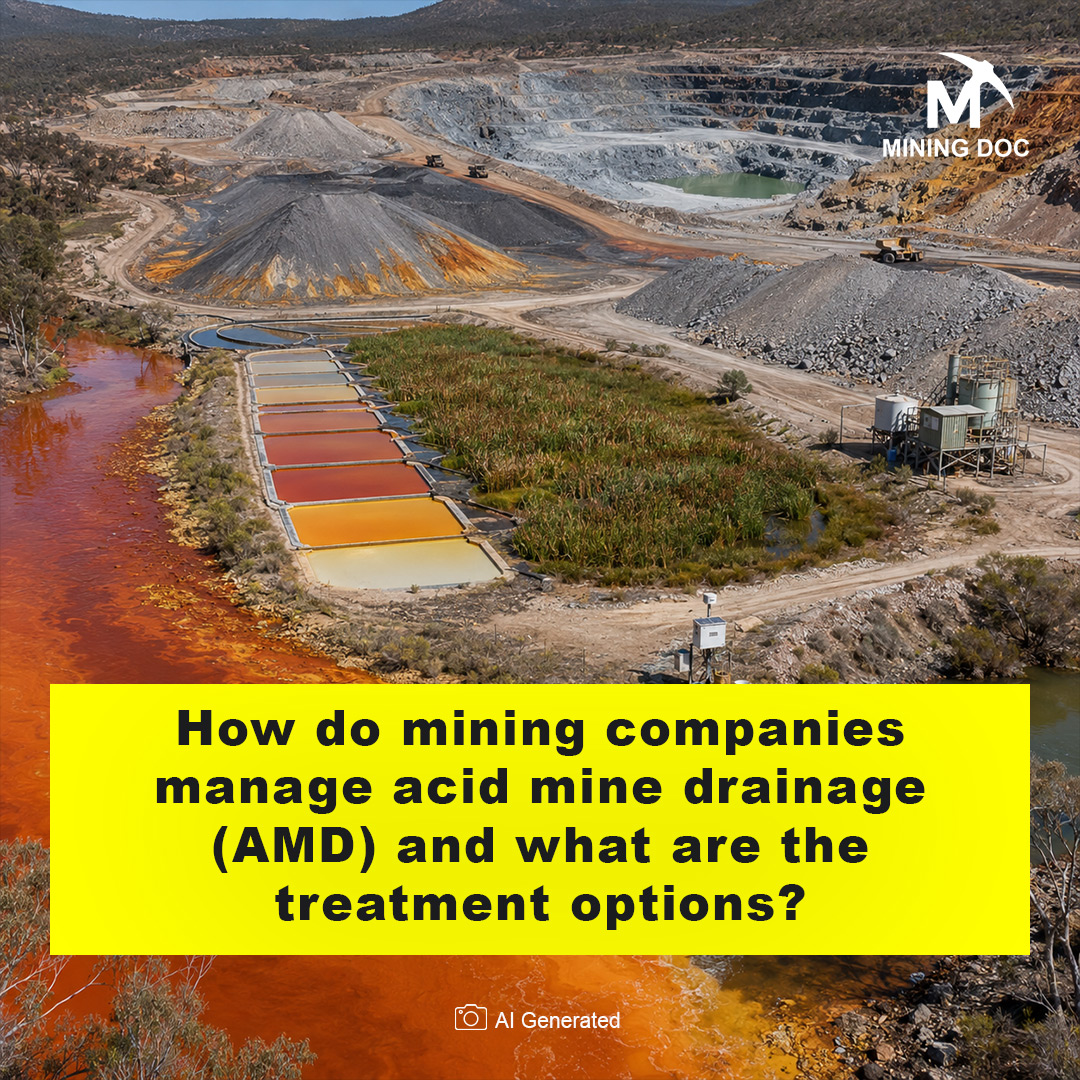
How do mining companies manage acid mine drainage (AMD) and what are the treatment options?

  • 0
  • 0

Acid mine drainage refers to the formation of acidic, metal-bearing water resulting from the exposure of sulfide minerals, primarily pyrite (FeS2), to oxygen and water in the presence of acid-tolerant microorganisms. This leads to the generation of sulfuric acid and the mobilization of metals and sulfate ions into both surface and ground waters. Acid mine drainage produces effluents with a low pH (typically pH 2–6), elevated sulfate, iron, aluminum, and various toxic metals which can be harmful to aquatic ecosystems for extended periods.

Mineral resource extraction firms address AMD using a hierarchy of prevention, mitigation, monitoring, and remediation techniques that start even before a mining project commences and extend all the way to site decommissioning and post-mining care; initial activities involve source control via restricting sulfide exposure (using engineered covers, subaqueous disposal, or backfilling); surface water drainage away from reactive zones, and waste segregation to protect reactive minerals.

It is important to undertake mineral characterization as well as geochemical modeling during the exploration phase to help firms focus on the most reactive lithological units, dispose of wastes above the water table whenever possible, and set up water management systems such as drainage channels and lined water storage facilities to reduce contact with air. In addition, monitoring networks for surface and groundwater quality are implemented alongside adaptive management strategies, whereby an increase in water acidification triggers stronger control/management actions.

In many cases, active treatment is a popular approach to use if there is a need for consistent and effective neutralization. The most popular active neutralization technology uses lime (Ca(OH)2) or another alkaline chemical in order to increase the pH level and form metal precipitates as hydroxides; it may be complemented by separation and disposal of metal-containing sludge in special installations. In addition, it is possible to neutralize the wastewater using such chemicals as caustic soda, sodium carbonate, or calcium silicate, remove metals through ion exchange or membranes, and create high-density sludge for safe disposal.

Even though it requires constant supply of chemicals and power, active treatment ensures quick and manageable outcomes which are ideal for emergency situations or legislative needs.

Passive systems are designed to harness the power of natural chemical reactions and biological activities while requiring minimal amounts of energy, which makes them economical for treating moderate to heavy loads of AMD; examples of passive systems include anoxic limestone drains (ALDs), constructed wetlands (aerobic and anaerobic), successive alkalinity producing systems (SAPS), and sulfate-reducing bioreactors that precipitate metals as sulfides.

Wetland systems, for example, can help oxidize and settle metals in aerobic units or form metal sulfides in anaerobic units due to increased pH levels caused by organic substrates and the growth of sulfate-reducing bacteria in these units. However, ALDs and limestone systems offer alkalinity production but can be hindered by armouring and clogging under high metal loads.

Mine design and source control strategies can be used along with mitigation techniques, either as prevention of acid mine drainage or as minimization of its effects, which include the subaqueous disposal of the sulfide mineral material, placement of alkaline materials in the waste rock material, encasing in low-permeability caps, and controlling the run-off through surface water diversion.

In cases where the mine has been abandoned or is considered to be old or historical, options such as digging up and transporting the reactive materials to safer places, flooding of the mines, in situ addition of alkaline materials, and the construction of treatment facilities can be employed depending on the nature of the location being worked on.

The decision on a treatment method should incorporate characterization, anticipated load and life expectancy, costs, operational ability, and environmental objectives; Active treatment provides a sense of control and quick compliance but incurs greater life cycle operational costs than Passive treatment, which reduces operational requirements but occupies more land and has lesser predictability in dealing with fluctuating loadings. The use of a hybrid system incorporating source controls and passive treatment for basic load with active treatment as a supplementary measure is popular in present-day mining and recommended by practitioners as well as science reviews.

How do mining companies manage acid mine drainage (AMD) and what are the treatment options?
0
  • 0 0 Comments
  • 18 Views
  • 16 Reactions
  • 0 Followers
  • 0
    • Report
  • Share
    Share
    • Share on Facebook
    • Share on Twitter
    • Share on LinkedIn
    • Share on WhatsApp

Related Posts

  • How is an all-in sustaining cost (AISC) calculated and why is it the preferred cost metric in gold mining?
  • What is the significance of critical minerals in the transition to a green energy economy?
  • The real value of responsible mining

You must login to add an Comment.


Forgot Password?

Need An Account, Sign Up Here
aalanaalan

Sidebar

  • Recent
  • 200 TPH Stone Crusher Price in Mining Industry for Limestone, Granite, and Basalt Crushing Projects
    • On: May 12, 2026

    200 TPH Stone Crusher Price in Mining Industry for Limestone, ...

  • Concrete Batching Plant Company Integration in Mining Infrastructure and Material Processing Projects
    • On: May 12, 2026

    Concrete Batching Plant Company Integration in Mining Infrastructure and Material ...

  • Next month, mining leaders unite to redefine innovation and sustainability globally
    • On: May 12, 2026

    Next month, mining leaders unite to redefine innovation and sustainability ...

  • On-Site Batching Plant Deployment Delivers Precision Mix for Ultra-Class Haul Road Performance
    • On: May 11, 2026

    On-Site Batching Plant Deployment Delivers Precision Mix for Ultra-Class Haul ...

  • Tackling the Complexities of Mixed Fleets in Autonomous Haulage
    • On: May 11, 2026

    Tackling the Complexities of Mixed Fleets in Autonomous Haulage

  • Portable Jaw Crusher Plant for Crushing Hard Rock Materials in Remote Mining Locations
    • On: May 8, 2026

    Portable Jaw Crusher Plant for Crushing Hard Rock Materials in ...

  • Terafil Technologies: Redefining Dust Control in Modern Mining Operations
    • On: May 7, 2026

    Terafil Technologies: Redefining Dust Control in Modern Mining Operations

Go to Home page to view more

Top Members

Olena Skyba

Olena Skyba

  • 150 Posts
  • 2 Comments
Pundit
Marcial

Marcial

  • 91 Posts
  • 0 Comments
Enlightened
Jean Marais (Sanodea Group)

Jean Marais (Sanodea Group)

  • 25 Posts
  • 0 Comments
Beginner
Trending on Mining Doc

Trending Communities

Fixed Plant General Information Geology Mining Case Studies Mining Doc Documentary Mining Engineering Mining Events Mining Finance and Economy Mining Human Resources Mining Industry Research Mining Operations Mining Software Solutions Mining Sustainability Mining Technology Solutions Mobile Plant Equipment

Explore

  • Home
  • Online courses
  • Case study
  • Mining Community
  • Solutions listing
    • Lase Solutions
    • O-PitBlast Solutions
    • Continuous Mining
    • Longwall mining
    • Geosight Scanners
    • LoopX AI
    • Terafil solutions
    • Blasting solutions
    • Geotechnical
    • Submersible Pumps
    • Mine rescue system
    • Ore sorting
    • Whittle Consulting Solutions
  • Add Blog
  • Feed
  • User Profile
  • Posts
    • New Posts
    • Trending Posts
    • Must read Posts
    • Hot Posts
  • Polls
  • Badges

Footer

Mining Doc

Join our community and connect with other people in the Mining industry for knowledge sharing.

Legal Stuff

  • Privacy Policy
  • Terms of Service

Help

  • Support
  • FAQs
  • How to add new content and how to promote a content
  • Compliance and guidelines
  • Subscribe to Mining Doc

Follow

© 2026 Mining Doc. All Rights Reserved