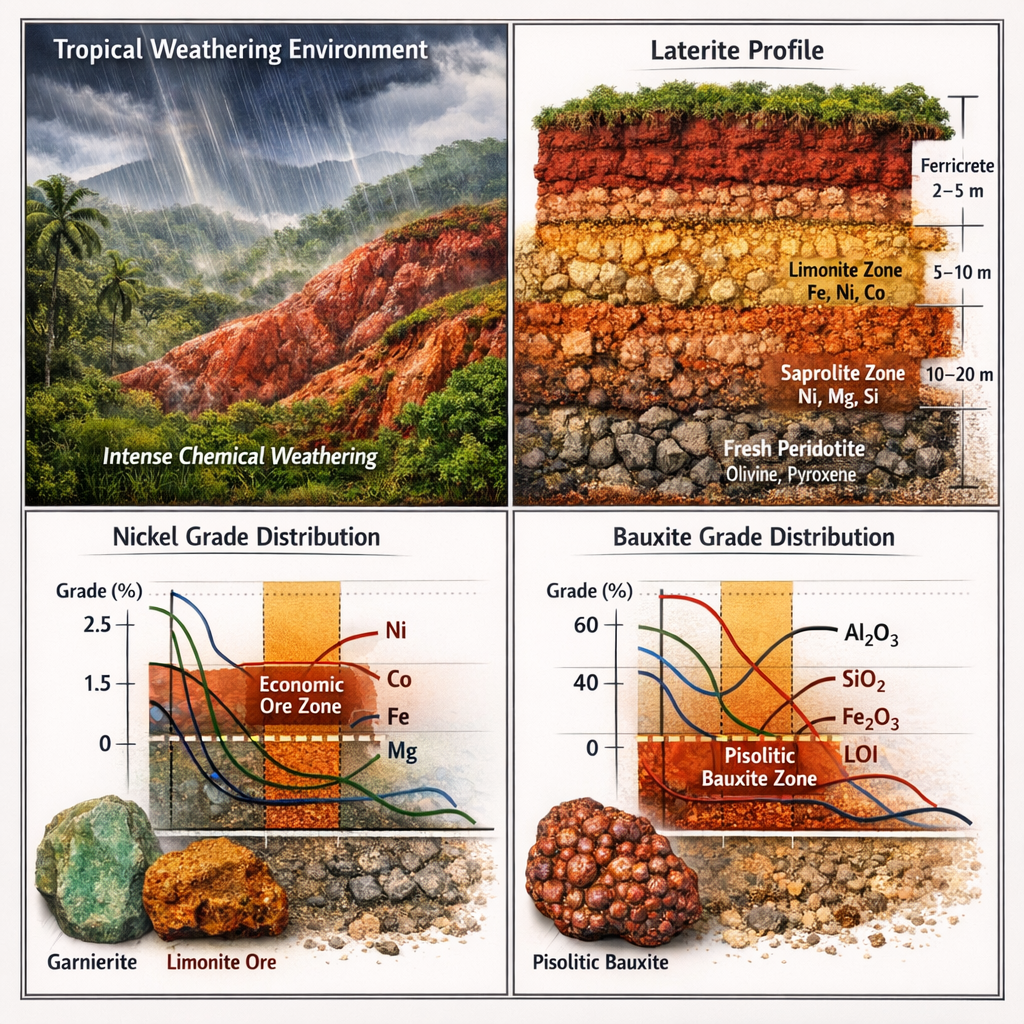
The formation of high-grade lateritic nickel and bauxite deposits is fundamentally a result of intense chemical weathering, a process that transforms relatively low-grade parent rocks into economic ore bodies through selective leaching and residual enrichment.
While both deposit types rely on tropical or sub-tropical weathering conditions, the specific mechanisms of enrichment differ based on the mobility of the target elements (nickel and aluminum) within the weathering profile.
Weathering affects ore grades primarily through the removal of mobile constituents, such as magnesium (Mg) and silica (Si), which leaves behind less mobile elements like iron (Fe) and aluminum (Al) in the residual regolith (Fu et al., 2019).
In bauxite deposits, this process is known as “bauxitization.” As meteoric waters infiltrate aluminum-rich rocks (e.g., granites or clays), they dissolve silica and alkali metals, leading to the in-situ concentration of aluminum hydroxides like gibbsite (Taylor et al., 2008).
If leaching is incomplete, the deposit may remain a low-grade ferruginous laterite; however, prolonged weathering under optimal drainage conditions results in the high-grade alumina concentrations necessary for economic mining (Sijinkumar, 2014).
For lateritic nickel deposits, weathering creates a vertical profile typically divided into limonite and saprolite zones. Unlike aluminum, which remains largely stationary, nickel (Ni) often undergoes “supergene enrichment.” As the ultramafic parent rock (often serpentinite) weathers, Ni is released from primary minerals and carried downward by groundwater (Ilyas et al., 2016).
- Limonite zone: in the upper, highly oxidized layer, Ni is often trapped by adsorption or substitution within iron-oxy-hydroxides like goethite (Ilyas et al., 2016).
- Saprolite zone: below the limonite, Ni-rich fluids react with magnesium silicates to form high-grade “garnierite” or secondary serpentine, often reaching grades significantly higher than the original bedrock (Fu et al., 2019).
The ultimate grade of these deposits is heavily influenced by topography and the paleo-groundwater system. Moderate slopes (5–19°) are often ideal, as they balance the need for water infiltration (to drive chemical reactions) with the need for drainage (to remove leached waste products) (Ilyas et al., 2016). Without this balance, the weathering process might stall, or the accumulating ore might be lost to physical erosion before it reaches economic grades.
References
Fu, W., Feng, Y., Luo, P., Zhang, Y., Huang, X., Zeng, X., Cai, Q., & Zhou, Y. (2019). Weathering of Ophiolite Remnant and Formation of Ni Laterite in a Strong Uplifted Tectonic Region (Yuanjiang, Southwest China). Minerals, 9(1), 51.
Ilyas, A., Kashiwaya, K., & Koike, K. (2016). Ni grade distribution in laterite characterized from geostatistics, topography and the paleo-groundwater system in Sorowako, Indonesia. Journal of Geochemical Exploration, 165, 174–188.
Sijinkumar, A. V. (2014). A preliminary assessment of environmental impacts due to bauxite and laterite mining in Karindalam and Kinanur, southern India. International Journal of Conservation Science, 5(2), 235–242.
Taylor, G., Eggleton, R. A., Foster, L. D., & Morgan, C. M. (2008). Landscapes and regolith of Weipa, northern Australia. Australian Journal of Earth Sciences, 55(S1), S3–S16. https://doi.org/10.1080/08120090802438225