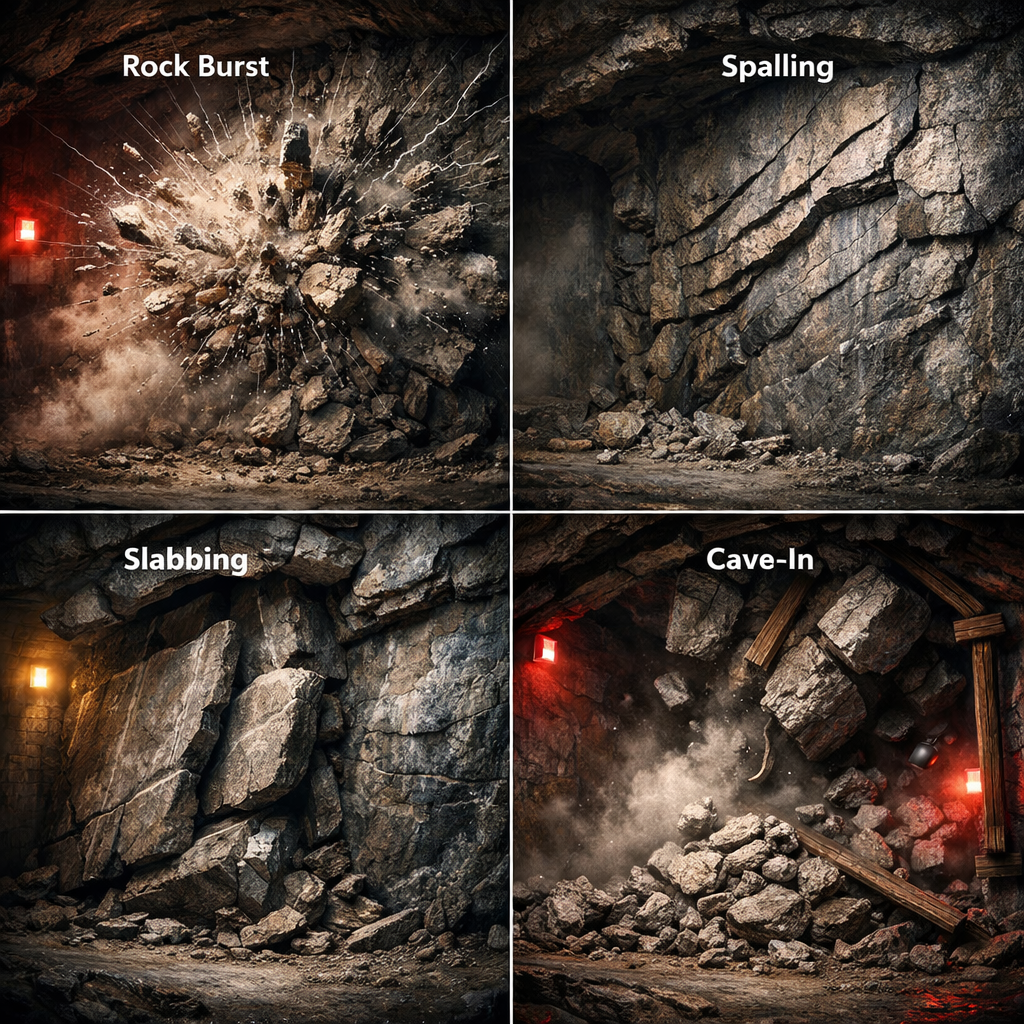
Understanding the mechanics of ground failure is fundamental to safe underground mining and tunnelling. As excavations extend to greater depths, the stress conditions change, leading to distinct types of rock mass deformation and collapse. The primary failure modes include rock bursts, spalling, slabbing, and cave-ins, each with unique characteristics and causes.
Rock bursts
A rock burst is a violent and dynamic failure of overstressed rock, characterized by the sudden and explosive ejection of rock fragments from the excavation walls (Quanping et al., 2026). This phenomenon is a major hazard in deep coal and hard-rock mines. According to Quanping et al. (2026), rock bursts are a “multi-factor coupling” disaster, triggered by the interplay of high in-situ stresses, mining-induced stress, and the properties of the coal-rock mass. The consequences are severe, including fatalities, destruction of mining equipment, and the complete disruption of production.
Spalling
Spalling refers to the stress-induced, progressive fracturing and detachment of rock fragments from an excavation’s surface. Unlike a rock burst, spalling is generally a non-violent, time-dependent process. Gorain et al. (2025) describe side spalling in coal pillars as a persistent challenge driven by mining-induced stress concentrations, particularly in mechanized mining. Field data show that spalling can lead to significant pillar dilation and degradation, with spalling depths reaching 3 to 6 meters. If left unmitigated, this progressive failure reduces the load-bearing capacity of pillars and can compromise the overall stability of the mine.
Slabbing
Closely related to spalling, slabbing is a specific mode of failure where relatively thin, plate-like rock fragments, or “slabs,” form parallel to the high-stress boundary of an excavation. Wang et al. (2024) explain that in deep hard-rock tunnels, slabbing is a common brittle failure mechanism driven by high ground stress and excavation disturbance. Their research highlights how the heterogeneity of the rock mass influences this failure, with stress concentrations causing the rock to fracture and separate into slabs, increasing the risk of collapse at the tunnel crown.
Cave-ins
A cave-in is a large-scale, often gravity-driven collapse of underground workings, frequently resulting from a loss of structural integrity in the roof or pillars. This type of failure is commonly associated with weak rock, poor ground conditions, or inadequate engineering controls. A devastating example occurred at unregulated artisanal mines, where tunnels are often hand-dug without proper support. As reported by McMakin, (2026), heavy rains and poorly constructed parallel tunnels led to a catastrophic cave-in, highlighting how a lack of structural support and safe evacuation routes can result in deadly, large-scale ground collapses.
References
Gorain, S., Kumar, A., Ram, S., & Kumar, D. (n.d.). Preventing and Mitigating Side Spalling in Bord and Pillar Mining Methods: A Comparative Study. Retrieved March 4, 2026, from https://dx.doi.org/10.56952/ARMA-2025-0516
Quanping Z., Shaokang W. U., Yinghao H. a. O., Xinzhen W., Fengba J., Ruxin Y., Caiquan O. U., & Jiakun D. (2026). Research status and prospect of rock burst in coal mines in China: Mechanism, monitoring, early warning and prevention. Conservation and Utilization of Mineral Resources. http://kcbhyly.xml-journal.net/en/article/id/78c67a09-05eb-47d1-b7e1-d56e7a4dec13
Wang, Y., Zhang, Q., Yuan, L., Wang, X., Wang, S., & Wei, L. (2024). Spalling Failure Mechanism of Surrounding Rock in Deep Hard-Rock Tunnels. Geotechnical and Geological Engineering, 42(8), 7225–7242. https://doi.org/10.1007/s10706-024-02924-z
What to know after a deadly landslide in eastern Congo kills at least 200 miners | Britannica. (n.d.). Retrieved March 4, 2026, from https://www.britannica.com/news/1900305/b9fec43392b2b5b7de2857b4d33b8c8e