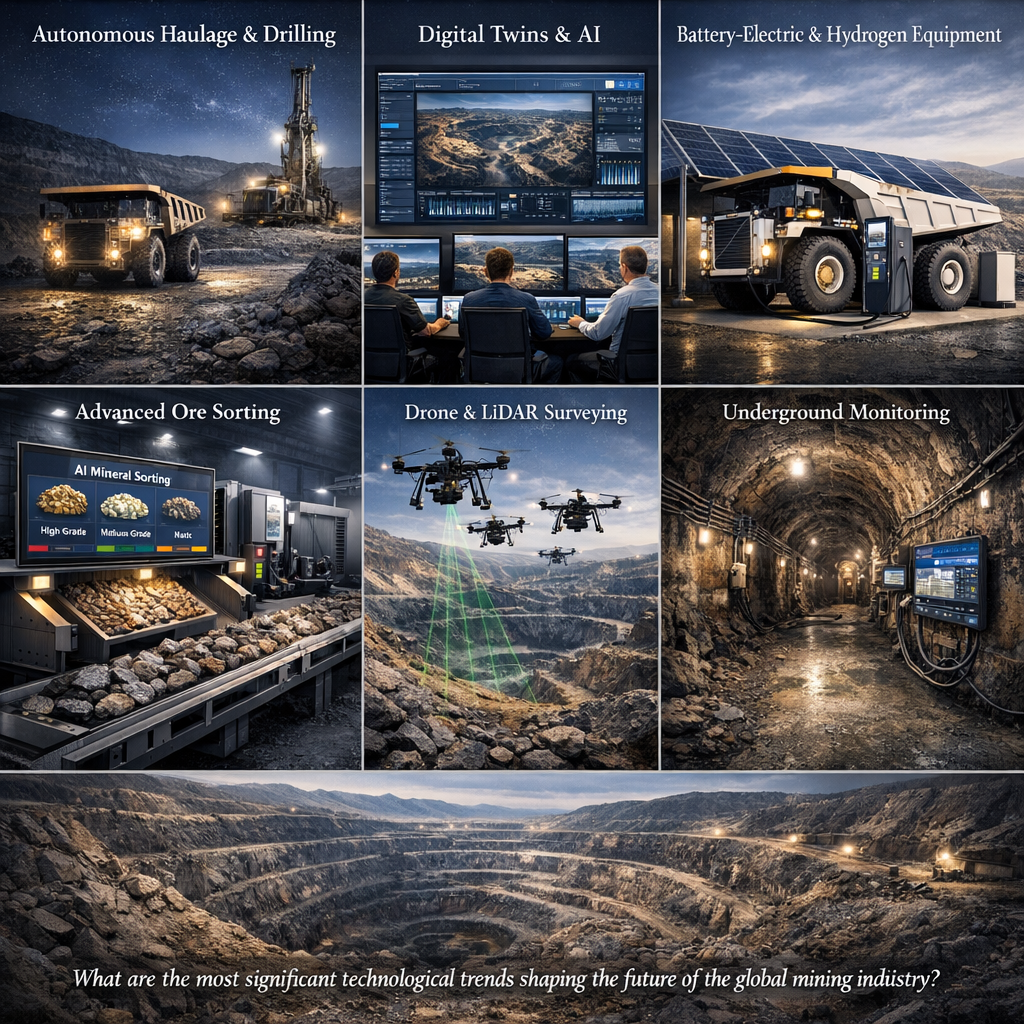
The global mining sector is currently undergoing a profound structural evolution, trading traditional, labour-intensive extraction methods for a digitalized and sustainable “Smart Mine” paradigm (Zvarivadza et al., 2024). This shift is not merely a trend but a necessity, driven by the dual pressures of improving operational efficiency in increasingly complex geological environments and meeting rigorous new environmental standards (Saleem, 2025).
Automation and autonomous systems
The most striking advancement in modern mining is the widespread deployment of Autonomous Haulage Systems (AHS) and robotic machinery. Mining sites are increasingly populated by self-driving trucks and automated drilling rigs that operate around the clock without human intervention (Saleem, 2025). By leveraging GPS, sophisticated sensor arrays, and AI algorithms, these systems drastically reduce machine downtime and optimize fuel consumption. More importantly, automation enhances safety by removing personnel from high-risk zones, such as deep underground tunnels or unstable open-pit faces (Saleem, 2025).
The industrial internet of things (IIoT) and digital twins
The integration of the Industrial Internet of Things (IIoT) has transformed mines into hyper-connected ecosystems. By embedding thousands of smart sensors across equipment and infrastructure, operators gain unprecedented, real-time visibility into every stage of the supply chain (Zvarivadza et al., 2024).
This connectivity is the foundation for Digital Twins (DT); virtual replicas of physical assets or entire mine sites (Ghahramanieisalou & Sattarvand, 2024). These virtual models allow engineers to run complex simulations and identify potential bottlenecks before they occur. For instance, Digital Twin frameworks are currently being used to monitor open-pit coal mines for real-time crack detection, enabling proactive intervention to prevent catastrophic failures (Yu et al., 2023).
AI and predictive maintenance
Artificial Intelligence (AI) is redefining asset management through the lens of predictive maintenance. Rather than waiting for a component to fail, AI models analyze historical and real-time data to spot the subtle anomalous patterns that precede a breakdown (Saleem, 2025). This foresight extends the lifespan of expensive machinery and slashes the costs associated with unplanned outages (Ghahramanieisalou & Sattarvand, 2024). Furthermore, AI-driven analytics are now essential for maximizing “mineral resource utilization efficiency,” ensuring that companies extract maximum value with a minimal environmental footprint (Tian et al., 2025).
Conclusion
The future of the industry is inextricably linked to its digital maturity. Through the convergence of autonomous robotics, IIoT connectivity, and AI-driven intelligence, mining is moving toward a model that is not only more profitable but fundamentally more resilient and responsible (Zvarivadza et al., 2024; Tian et al., 2025).
References
Ghahramanieisalou, M., & Sattarvand, J. (2024). Digital Twins and the Mining Industry. Technologies in Mining.
Saleem, M. (2025). Automation and artificial intelligence in enhancing mining efficiency and sustainability: a review. Procedia Environmental Science, Engineering and Management, 1(1), 213-228.
Tian, Y., et al. (2025). Research on the impact of digital economy development on mineral resource utilization efficiency. Frontiers in Earth Science, 12.
Yu, R., Yang, X., & Cheng, K. (2023). Deep learning and IoT enabled digital twin framework for monitoring open-pit coal mines. Frontiers in Energy Research, 11.
Zvarivadza, T., et al. (2024). On the impact of Industrial Internet of Things (IIoT) – mining sector perspectives. International Journal of Mining, Reclamation and Environment, 38, 771-809.