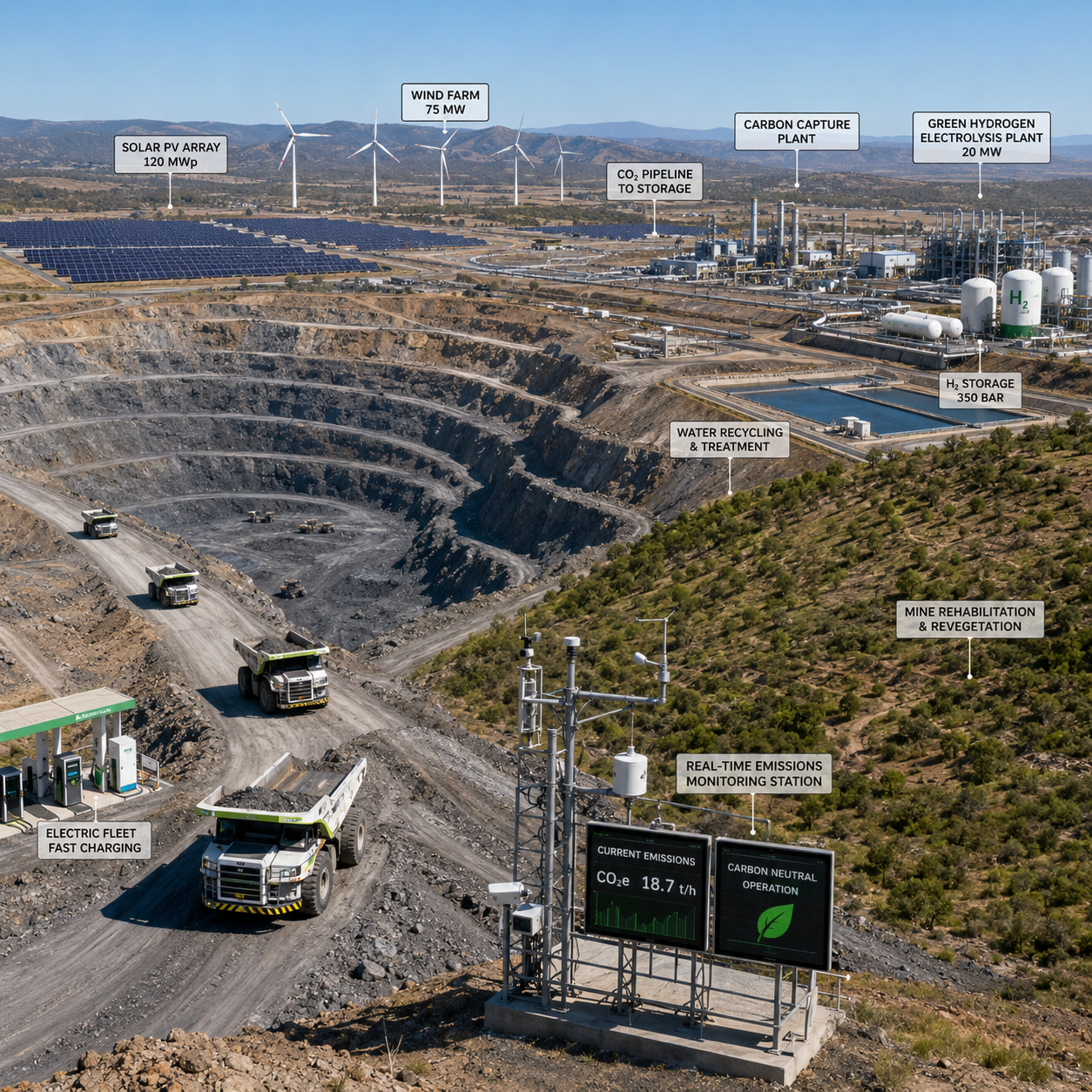
To make mining operations carbon neutral, a holistic engineering solution involving electrification, use of renewable energy sources, and technological innovations would be needed to address Scope 1 and Scope 2 emissions. One of the most effective ways to do this is to replace haul trucks, loaders, and drills powered by diesel engines with either battery-electric or hydrogen fuel cell models. Battery electric vehicles are zero emission and decrease energy usage in underground mines by up to half while also eliminating exhaust gas emissions. Using trolley assist for haul trucks involves fitting trucks with an electric overhead line that cuts down the use of diesel by 30–60%.
The mining industry is moving away from using diesel generators towards utilizing solar photovoltaic systems, wind energy systems, and battery energy storage systems (BESS) in combination with each other. This way, the share of solar/wind generation will cover 40-70 percent of total power generation, while battery storage would solve the problem of intermittency and act as backup power. The primary task for engineers is to improve the design of microgrids, install modern energy management systems (EMS), and estimate sufficient storage capacity during peak load periods for crushing and grinding processes.
Crushing and grinding processes account for 40% to 50% of energy use in mining operations, thus becoming a key source of energy consumption. The High-Pressure Grinding Roll (HPGR) process, vertical roller mill processes, and stirred media mills use 20% to 30% less energy compared to traditional ball mill methods. Engineers employ ore sorting technology with sensor-based and AI-driven systems for discarding waste material without crushing it.
Ventilation alone may account for 30% to 50% of energy consumption in underground mines. The engineering solutions include the implementation of on-demand ventilation technology that changes the volume of ventilation depending on the location of machinery and gas detection. This method will lead to reduction in fan energy consumption by 40% to 60%. Heat recovery systems can be used to recover energy from compressor exhaust and ventilation exhaust for heating or running an absorption chiller.
In cases where battery electrification cannot be considered feasible (very large haul trucks, primary crushing), there are trials underway using hydrogen fuel cell technology and hydrogen-powered internal combustion engines. Hydrogen produced through electrolysis from renewable energy sources is an alternative to diesel for powering heavy-duty machinery and serving as backup electricity generation. Issues that need to be tackled by engineers relate to storing hydrogen under high pressure, integrating the fuel cell with the existing machine, and safe handling processes.
In situations where emissions cannot yet be prevented (such as process emissions through calcination), engineering solutions may involve the use of CCU processes, whereby carbon dioxide is injected into the tailings facilities, causing its permanent mineralization in the form of stable carbonates. Engineering also entails the use of nature-based solutions such as forestation and restoring wetlands as means for offsetting residual emissions. All in all, engineering solutions create an approach to achieving a carbon-neutral mine through both efficiency and technology changes.