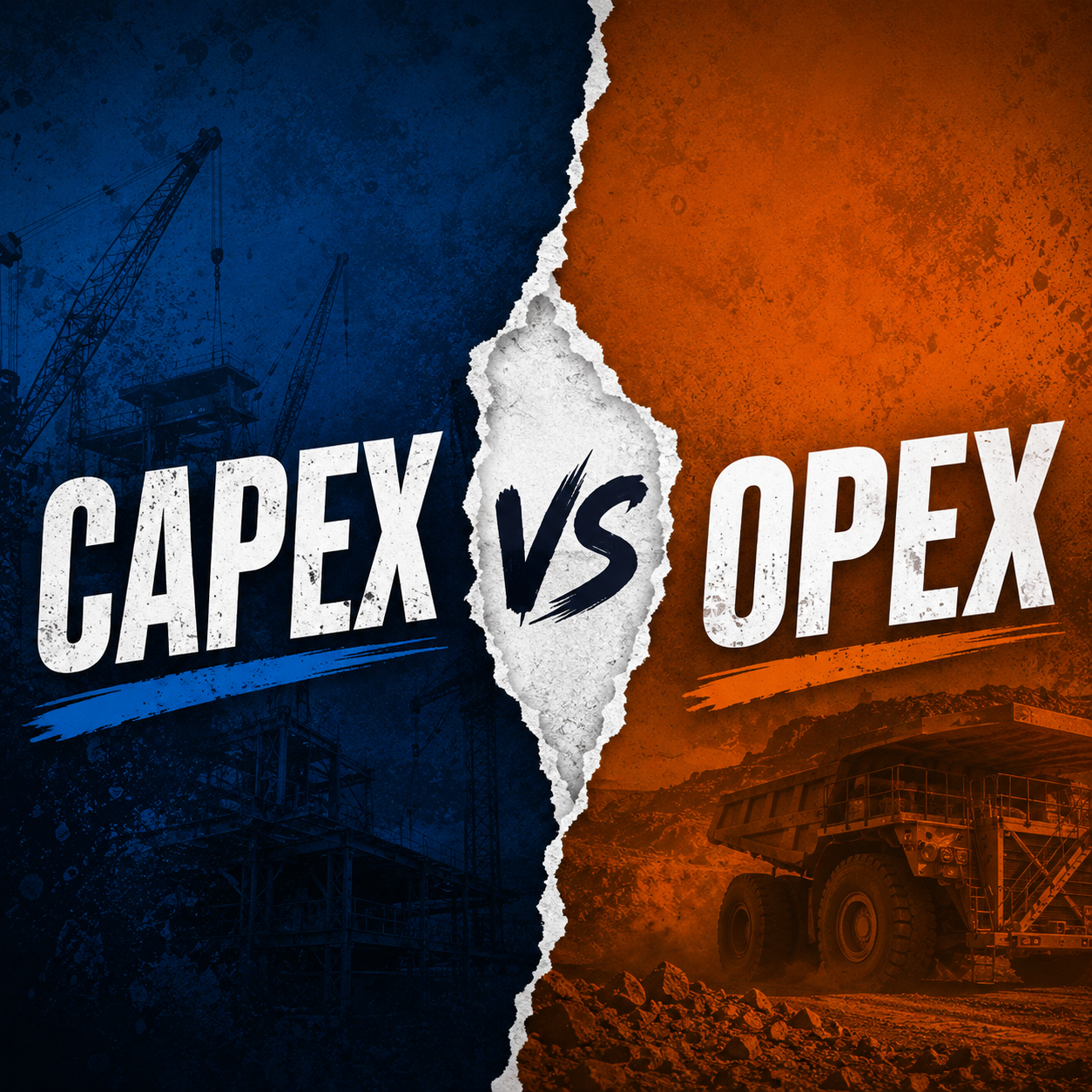
When it comes to the economics of mining, it is extremely difficult, if not impossible, to describe the industry without addressing two key concepts: capital expenditure (CAPEX) and operating expenditure (OPEX). These two terms form the basis of mining economics and provide an understanding of how mining projects are financed.
In the mining industry, CAPEX refers to expenditure that will be incurred when acquiring/building/materially improving assets used in production in the future, whereas OPEX refers to the cost involved in running the mining activities in the short term. CAPEX will include expenditures like purchasing mobile equipment, developing the mine, building the plant, constructing the tailings area, building roads, etc., while OPEX will involve costs like fuel, power generation, consumables, labor, tires, contractor fees, spare parts, etc.
One way of distinguishing between the two is to consider whether the expenditure creates a long-term asset or simply sustains the mining operation. For example, if a mine purchases a haul truck, builds a workshop, or expands an existing processing facility, then this expenditure falls under CAPEX since its benefits span several years. On the contrary, the purchase of diesel, paying shift labor, maintenance service charges, and consumable replacement will be classified as OPEX since it is directly related to the current level of production.
There is also a distinction in accounting treatment. Capital expenditure is normally capitalized on the balance sheet and then written off either through depreciation or amortization according to the useful economic life of the asset, while operational expenditure is immediately charged against income and appears in the income statement. This is relevant as capital expenditure has an impact on the value of assets, capital structure, and project economics over the long term, while operational expenditure influences profitability and unit cost per tonne immediately. Both of them are significant in the case of a mining enterprise but are treated differently in accounting.
As far as the process of project development is concerned, CAPEX usually reaches its maximum before start of production or in connection with expansion projects. The creation of a new mining operation requires substantial investments in pit development, shafts, plant facilities, power supply system, accommodation facilities, and haulage system prior to starting operations and earning revenues. However, after the start of production, OPEX becomes crucial for the project due to the repetitive nature of the extraction, haulage, and processing activities.
The difference will also influence business decisions, where most capital investment projects require board approvals, feasibility studies, risk assessments, and financing for the longer term, since they involve commitments of significant funds for future gains. Operating expenditure is controlled by production planning, maintenance procedures, fuel consumption, staffing considerations, and procurement practices, since even minor cost reductions may have an enormous impact on operating margins. Mining managers should strike the right balance between CAPEX and OPEX by spending just enough funds on CAPEX to ensure future production and minimizing OPEX to maintain their competitiveness.
In mining, a typical CAPEX-OPEX example would be this: purchasing a new excavator is CAPEX, whereas the diesel fuel to operate it, the labor expense to pay its operator, and the costs involved to maintain it are OPEX. Constructing a concentrator is CAPEX, whereas its chemical additives, electricity, and maintenance expenses to make it work are OPEX.