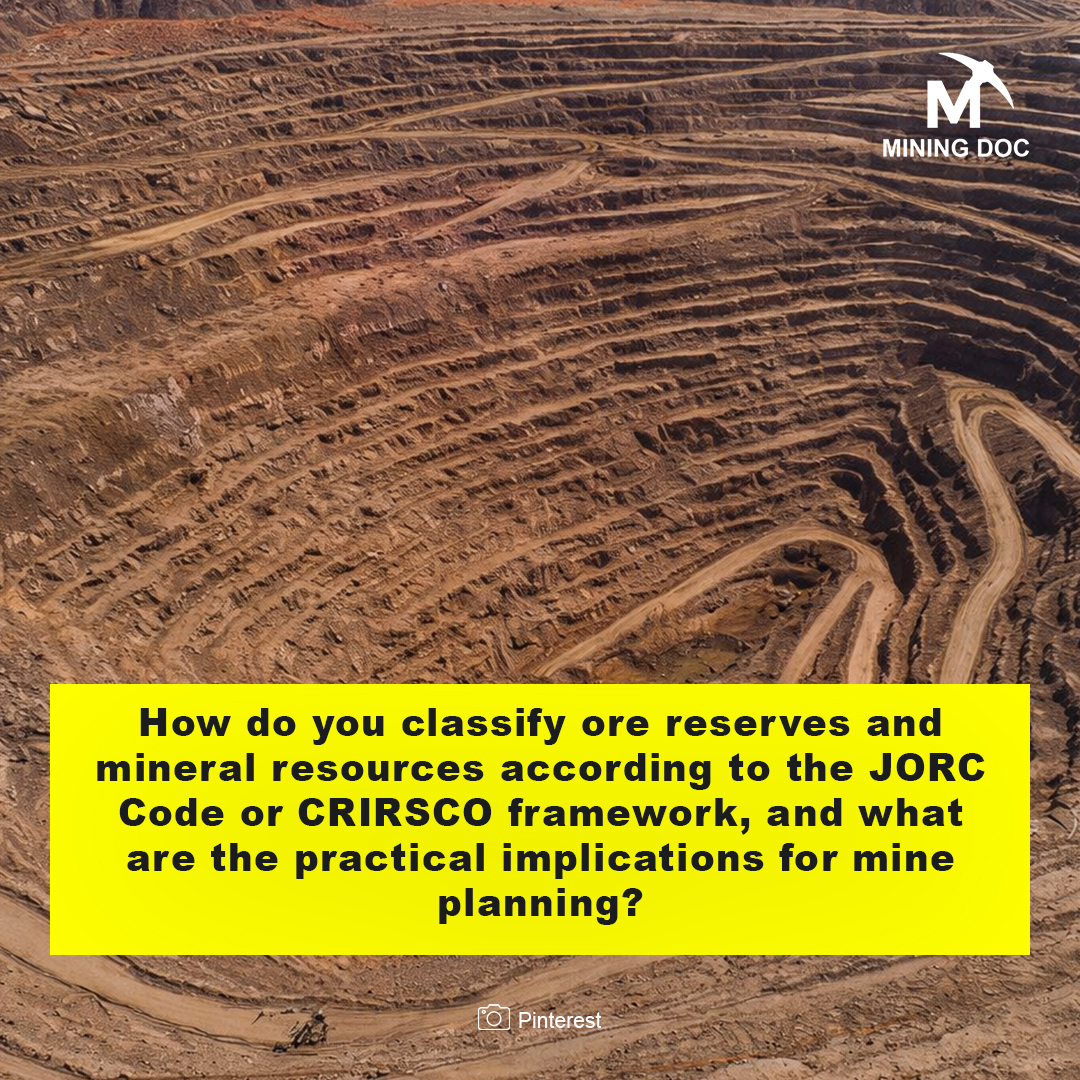
A mineral resource can be described as a concentration of material found within the Earth’s crust, which exists in a state and quantity where its eventual economic recovery is possible. On the other hand, an ore reserve is the portion of a resource that can be mined economically. Assessing such resources entails a careful analysis of the geological variation to establish how much a deposit contains and its value (Dumakor-Dupey & Arya, 2021).
There exist certain standards to make the evaluation of these resources simpler on an international scale. Some of them include JORC (Joint Ore Reserves Committee) and CRIRSCO (Committee for Mineral Reserves International Reporting Standards) codes. These two frameworks use some common language and principles, the goal of which is making sure that clarity, materiality, and competence is achieved. This helps to ensure that international investors and experts in the field deal with geological uncertainties comfortably (Moore & Friederich, 2021).
The CRIRSCO model classifies mineral resources into three different categories depending on their geological confidence as follows: Inferred, Indicated, and Measured. Inferred resources are characterized by the least degree of geological confidence since they depend on sparse geological information and samples. Indicated resources contain enough information to be sure of grade continuity. Measured resources have the highest degree of geological confidence due to dense sample information that proves the continuity of mineral grades.
If the mineral project is deemed economically feasible, Indicated and Measured resources can be upgraded to Ore Reserves that fall into two further categories of Probable and Proved. This upgrade involves the incorporation of “Modifying Factors,” which include mining, metallurgical, economic, marketing, environmental, and social factors among others. The proper classification of these reserves helps in safeguarding the interests of investors who understand the underlying risks involved in mineral exploration and development (Sides & Allington, 2024).
Consequently, there are significant implications of such classifications for the process of mine planning. Mine plans are made using block models that are created by converting reserves. Since only Proved and Probable reserves can be used when showing a project’s profitability during feasibility studies, proper classification of reserves plays a vital role in allocating finances, selecting equipment, and determining a project’s depreciation rates.
In conclusion, the classification of ore reserves and mineral resources in accordance with the guidelines of JORC and CRIRSCO serves as a link between information gathered from geological studies and actual mining operations. Through proper estimation of uncertainty, mining companies can reduce the level of operational risk in their projects and ensure the effective development of their mineral resources.
References
Dumakor-Dupey, N. K., & Arya, S. (2021). Machine learning—A review of applications in mineral resource estimation. Energies, 14(14), 4079. https://doi.org/10.3390/en14144079
Moore, T. A., & Friederich, M. C. (2021). Defining uncertainty: Comparing resource/reserve classification systems for coal and coal seam gas. Energies, 14(19), 6245. https://doi.org/10.3390/en14196245
Sides, E., & Allington, R. (2024). Mineral reporting standards: PERC’s role in CRIRSCO and its relevance to the European mining sector. Earth Science, Systems and Society, 4. https://doi.org/10.3389/esss.2024.10080