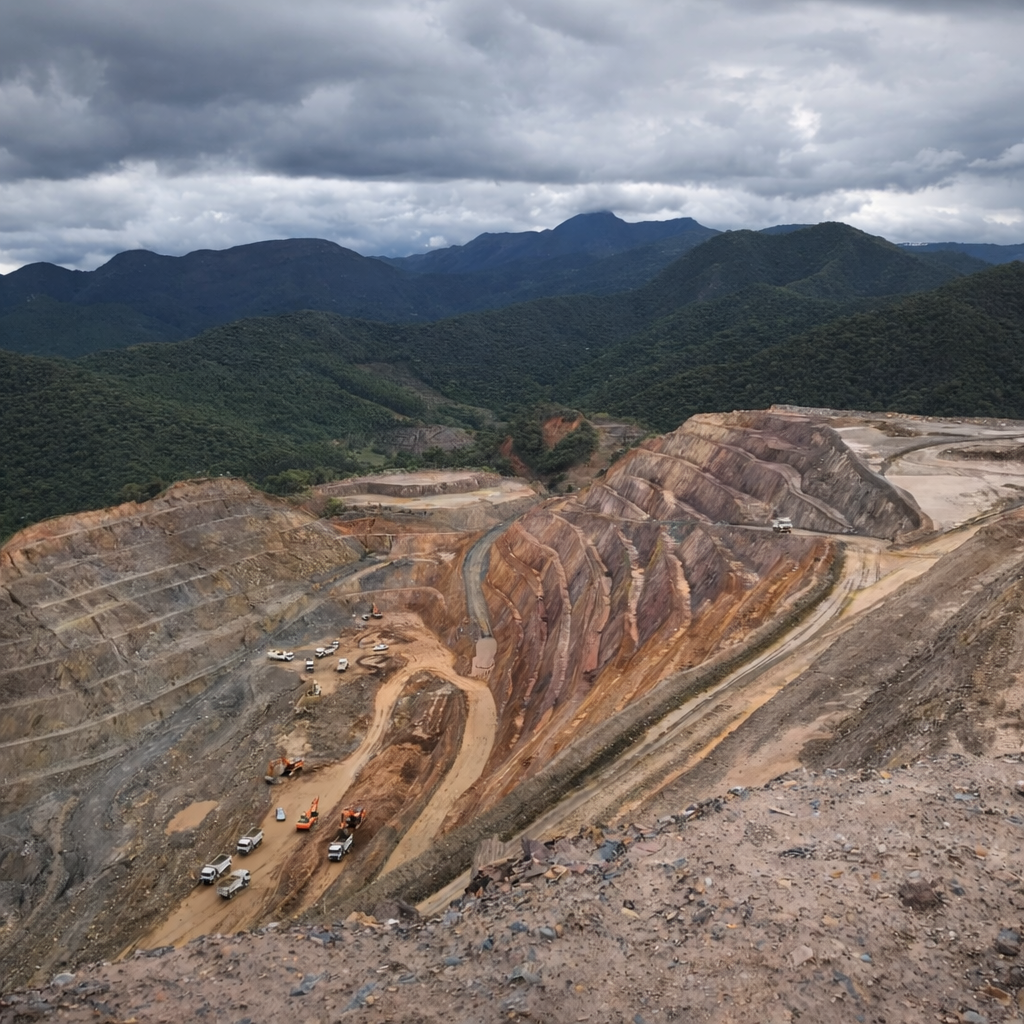
AGA Mineração, a subsidiary of the international mining company AngloGold Ashanti, has a number of complex underground gold mines in Brazil. For understanding these operations, one should start by defining orogenic gold deposits, which are essentially those epigenetic mineral deposits created due to tectonic movements. In this regard, the focus of operations conducted by AGA Mineração is on orogenic deposits in the Quadrilátero Ferrífero (QF), an important part of Brazil’s gold cycle (Morales et al., 2016).
In terms of geology, these mines have deep connections with the Neoarchean Rio das Velhas greenstone belt that has been known for housing numerous world-class gold deposits that were active at 2780 and 2700 million years ago (Morales et al., 2016). Some major operations by AGA Mineração include the exploitation of gold from ancient lithologies found in areas such as the Cuiabá and Lamego mines.
The mineral deposits at Lamego and Cuiabá occur mostly within the banded iron formations and carbonaceous phyllite units (de Souza Martins et al., 2016). The alteration of the structure of the Archean rocks made possible the entry of the hydrothermal fluids that deposited gold (Morales et al., 2016). In most cases, the mineral deposits include the gold minerals together with pyrite and arsenopyrite minerals.
The extreme heterogeneity exhibited by the gold deposits in Quadrilátero Ferrífero requires advanced processing techniques. Geometallurgy is applied with strictness for assessing variability and its relationship with processing. In order to increase gold recovery rates, AGA Mineração utilizes both gravity separation and froth flotation, where sulfide-rich rocks yield high gold recoveries with proper process design.
However, besides the technical problems associated with extraction, AGA Mineração also faces a number of challenges with respect to the management of waste material. Having been active for years, AGA Mineração had produced great amounts of tailings as a result of gold ore processing (Lemos et al., 2023). The current geochemical and mineralogical research is oriented at studying auriferous tailing deposits with an emphasis on their potential reuse (Lemos et al., 2023).
To conclude, AGA Mineração provides a perfect example of deep underground mining operations in contemporary conditions. With the help of comprehensive geologic mapping and careful geometallurgical ore processing, the company managed to overcome numerous problems involved in the extraction of gold from Archean BIF-hosted ores (de Souza Martins et al., 2016).
References
de Souza Martins, B., Lobato, L. M., Rosière, C. A., Hagemann, S. G., Santos, J. O. S., Villanova, F. L. S. P., Figueiredo e Silva, R. C., & de Ávila Lemos, L. H. (2016). The Archean BIF-hosted Lamego gold deposit, Rio das Velhas greenstone belt, Quadrilátero Ferrífero: Evidence for Cambrian structural modification of an Archean orogenic gold deposit. Ore Geology Reviews, 72, 963–988. https://doi.org/10.1016/j.oregeorev.2015.08.025
Lemos, M., Valente, T., Reis, P. M., Fonseca, R., Pantaleão, J. P., Guabiroba, F., Filho, J. G., Magalhães, M., Afonseca, B., Silva, A. R., & Delbem, I. (2023). Geochemistry and mineralogy of auriferous tailings deposits and their potential for reuse in Nova Lima Region, Brazil. Scientific Reports, 13. https://doi.org/10.1038/s41598-023-31133-6
Morales, M. J., Figueiredo e Silva, R. C., Lobato, L. M., Gomes, S. D., Gomes, C. C. C. O., & Banks, D. A. (2016). Metal source and fluid–rock interaction in the Archean BIF-hosted Lamego gold mineralization: Microthermometric and LA-ICP-MS analyses of fluid inclusions in quartz veins, Rio das Velhas greenstone belt, Brazil. Ore Geology Reviews, 72, 510–531. https://doi.org/10.1016/j.oregeorev.2015.08.009
Image rights: Nikolay Rusanov (Instagram)