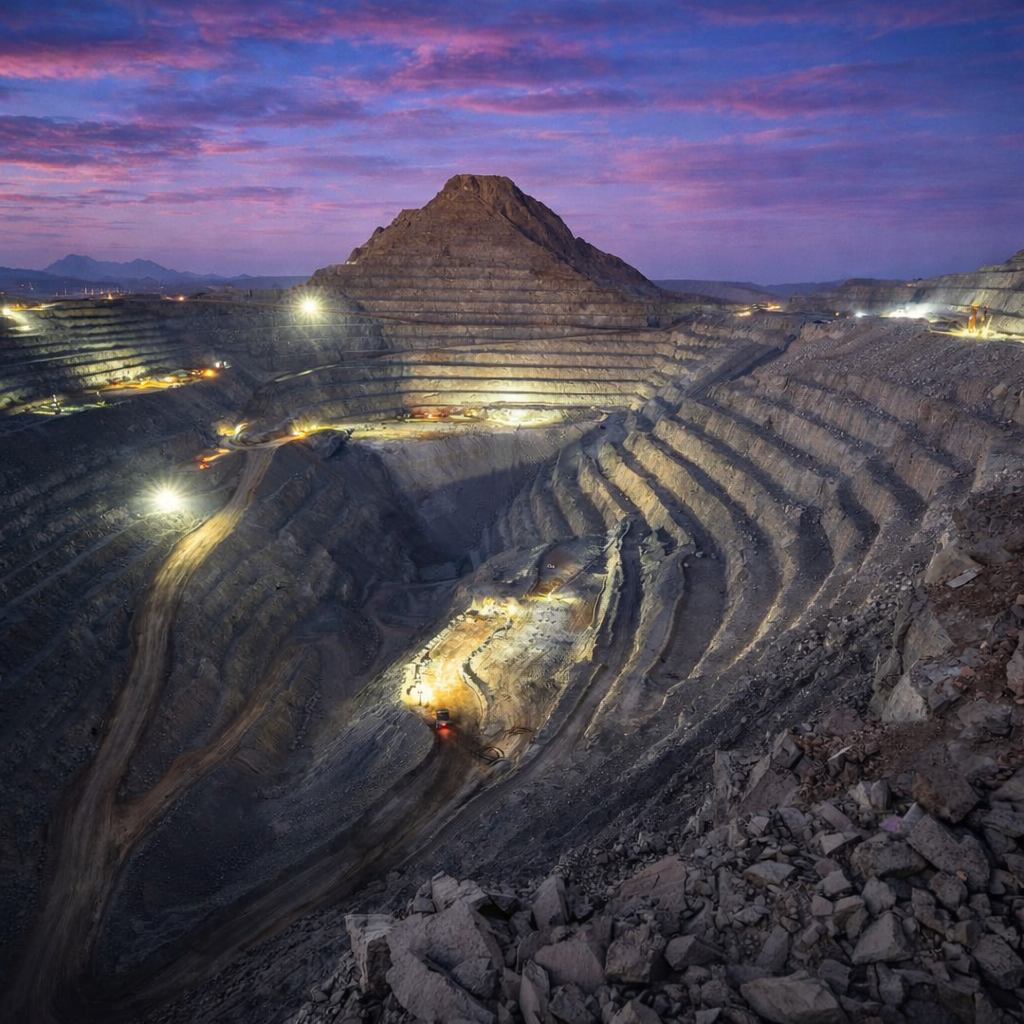
The Sukari gold deposit is situated in the dry Eastern Desert area, 25 km away from the Red Sea and belongs to the Arabian-Nubian Shield. The formation consists mainly of Neoproterozoic basement rocks, namely the Sukari granitoid porphyry, that cuts across the metamorphosed metavolcanic formations (Khalil et al., 2015). In the region, gold deposits occur in the form of quartz veins as well as shear zones affected by hydrothermal alteration due to tectonic activity during continental accretion (Kotb et al., 2024).
Although the ancient Egyptians were able to mine gold from the Sukari mines by 4000 BCE, the contemporary period for this site began much later. After significant geological surveying in the 20th century, the Australian company Centamin commenced its mining operation using advanced technology in 2009 (Badawy et al., 2023). This was when the creation of Egypt’s first modern commercial gold mine started under a joint venture agreement with the Egyptian Mineral Resource Authority.
The current mining processes at Sukari combine open pit and underground stoping methods. It is necessary to estimate the resources carefully since the gold veins are highly skewed and usually statistical algorithms are used for accurate grade control (Zaki et al., 2022). The mine yields hundreds of thousands of ounces each year with evaluated and demonstrated resources of about 13.7 million ounces (388,395 kg) along with 2.3 million ounces of inferred reserves (Badawy et al., 2023).
The financial impact of Sukari is large, being the driving force behind the present-day metal mining industry in Egypt. A 50% profit-sharing agreement is included in the concession contract along with a legal royalty fee, which creates hundreds of millions of foreign investments and revenue, provides employment to thousands of local people, and promotes development in the Red Sea Governorate.
Although the company has achieved great success financially, there are some environmental hazards that exist in connection with the process of gold extraction. Dust is emitted because of large machines and crushing, which affects air quality; also, chemical leaching needs to be managed properly to avoid hydrogeochemical pollution of the Quaternary aquifer (Ata et al., 2024). To make sure the risks mentioned above are avoided, monitoring and geochemical modeling as well as water reuse have been implemented.
References
Ata, A. A. E. M., Aly, M. H., Hussein, H., Eid, M. H., Abukhadra, M. R., El-Sherbeeny, A. M., Bellucci, S., & Gad, M. (2024). Hydrogeochemical characteristics and air quality risks associated with gold mining operations in Egypt using geochemical modeling and risk indices. Heliyon, 10(11), e31086. https://doi.org/10.1016/j.heliyon.2024.e31086
Badawy, W. M., Mitwalli, M., Dmitriev, A. Y., Chepurchenko, O., Saleh, G., El-Farrash, A., Bulavin, M., Morsi, T., & Sallah, M. (2023). Neutron Activation Analysis for Geochemical Characterization of Rocks from Gold Mines in Egypt. Applied Sciences, 13(7), 4564. https://doi.org/10.3390/app13074564
Khalil, S., Mesbah, M., Soliman, F., & Abd El-Khalek, I. (2015). Geological Evolution of Sukari Gold Mines Area- Eastern Desert, Egypt. Journal of Petroleum and Mining Engineering, 17, 29–38. https://doi.org/10.21608/jpme.2015.39907
Kotb, A., Gaber, G. M., Alzahrani, H., Okok, A., Elkhaliq, M. H. A., & Basheer, A. A. (2024). Unearthing Egypt’s Golden Legacy: Geophysical Insights and New Opportunities in the Central Eastern Desert. Minerals, 14(8), 787. https://doi.org/10.3390/min14080787
Zaki, M. M., Chen, S., Zhang, J., Feng, F., Khoreshok, A. A., Mahdy, M. A., & Salim, K. M. (2022). A Novel Approach for Resource Estimation of Highly Skewed Gold Using Machine Learning Algorithms. Minerals, 12(7), 900. https://doi.org/10.3390/min12070900