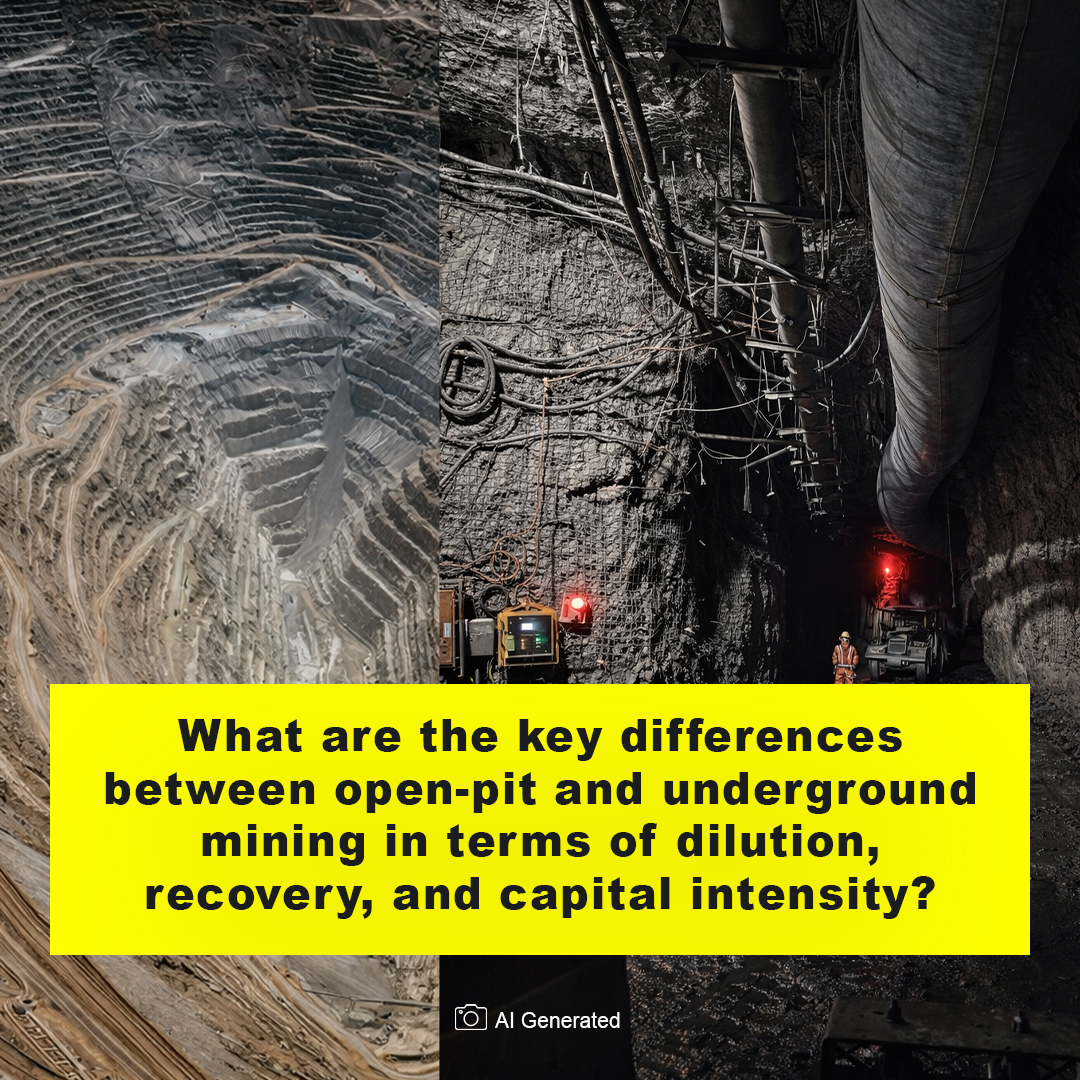
Open-pit mining is the type of surface mining where the overburden is removed in order to extract an ore body near the surface on bench by bench. Underground mining involves accessing ore bodies that are deeper into the ground using shafts, declines, or adits, and extracting ores using underground selective mining. Dilution occurs when the waste rock mixes up with the ore during extraction, leading to a lowering of the grade of ore supplied to the plant. on the other hand, recovery is defined as the percentage of the total amount of ore successfully extracted from the ore body.
Dilution in open pit mining is higher than that in underground mining due to use of large machines and bench blasting during mining process, which mix the waste rocks with ore. http mass blasting also results in dilution, but not as much as in underground mining. Selective mining techniques used in underground mining ensure that there is minimal dilution because high-grade ore zones can be accessed selectively. therefore, dilution in underground mining is less compared to open pit mining.
In terms of recovery, the open pit mining process often yields better results with recovery levels of 85% to 95% since the full ore deposit is exposed in the process. this makes it possible to recover all of the ore available from within the deposit without losing any material to the ground as in underground mining. recovery rates in underground mining are usually lower with a range between 60% and 80%. In underground mining, it is necessary to leave pillars in place for support purposes, which is one reason why some ore cannot be extracted. ore loss is one of the major issues in underground mining.
The differences between the two types of mining processes are especially obvious when comparing capital intensity of the projects. the cost structure of open-pit mining projects is not as capital intensive as that of underground mining due to the use of surface mining equipment that is relatively cheap compared to other equipment used in underground operations. Capital intensive operations are associated with complex engineering solutions for shaft sinking and ventilation systems. capital costs per ton of annual production are much higher in underground mining projects than open pit projects.
These operational trade-offs produce unique economic outcomes; open pit mining allows high throughput production with lower operational cost structures and makes low-grade mineral deposits economically feasible thanks to economy of scale, while underground mining produces high-grade ores at a costlier operational structure. The advantages of open pit mining include simple logistics, safe environment, and steady ore feed, compared to complex operational risks and high engineering requirements in underground mining. Selection of either method will affect processing performance, as the lower dilution rate from underground mining can enhance the beneficiation process although with lower recovery rates.
The final decision on which method to use in mining comes down to the depth, size, grade, and conditions of the deposit. mining shallow, large tonnage and low-grade deposits can be done via open pit mining with a lower capital investment and higher recovery rates, while mining deep and high grade or structurally complicated deposits will warrant using the underground mining approach despite the higher capital requirement. Environmental concerns also come into play; open pit mining involves huge land usage for rehabilitation, while underground mining involves little surface disturbance, making the latter preferable environmentally even with its high capital requirement.